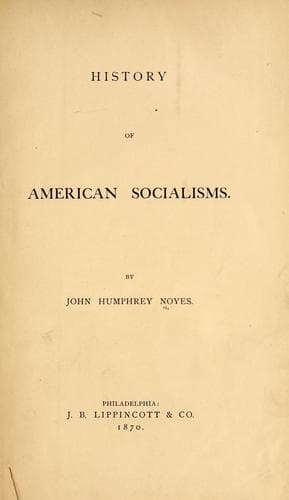
History of American SocialismsNoyes, John Humphrey
History
History of American Socialisms
Noyes, John Humphrey
Communism -- United States; Socialism -- United States
bread and meat; and declined to enter the harvest field or the
work-shop. A lecturer upon natural science insisted upon talking only,
while others worked. Mechanics, whose day's labor brought two dollars
into the common stock, insisted that they should, in justice, work
only half as long as the agriculturist, whose day's work brought but
one.
"For a while, of course, these jealousies were only felt; but they
soon began to be spoken also. It was useless to remind all parties
that the common labor of all ministered to the prosperity of the
Community. _Individual_ happiness was the law of nature, and it could
not be obliterated; and before a single year had passed, this law had
scattered the members of that society, which had come together so
earnestly and under such favorable circumstances, back into the
selfish world from which they came.
"The writer of this sketch has since heard the history of that
eventful year reviewed with honesty and earnestness by the best men
and most intelligent parties of that unfortunate social experiment.
They admitted the favorable circumstances which surrounded its
commencement; the intelligence, devotion, and earnestness which were
brought to the cause by its projectors; and its final, total failure.
And they rested ever after in the belief that man, though disposed to
philanthropy, is essentially selfish; and that a community of social
equality and common property is impossible."
CHAPTER VII.
NASHOBA.
Macdonald erects a magniloquent monument over the remains of Nashoba,
the experiment of Frances Wright. This woman, little known to the
present generation, was really the spiritual helpmate and better-half
of the Owens, in the socialistic revival of 1826. Our impression is,
not only that she was the leading woman in the communistic movement of
that period, but that she had a very important agency in starting two
other movements, that have had far greater success, and are at this
moment strong in public favor: viz., Anti-Slavery and Woman's Rights.
If justice were done, we are confident her name would figure high with
those of Lundy, Garrison, and John Brown on the one hand, and with
those of Abby Kelly, Lucy Stone and Anna Dickinson on the other. She
was indeed the pioneer of the "strong-minded women." We copy the most
important parts of Macdonald's memoir of Nashoba:
Public-domain text, read in full here on John Shaqi.
Reviews
Reviews
No reviews yet
Be the first to share your thoughts on this work.
Join the Discussion
Join the discussion
Sign in to leave a comment or review.
Sign InorCreate an account