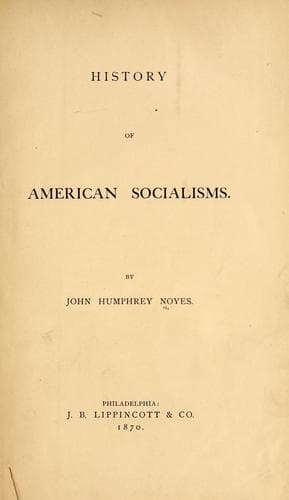
History of American SocialismsNoyes, John Humphrey
History
History of American Socialisms
Noyes, John Humphrey
Communism -- United States; Socialism -- United States
"In the year 1840 Dr. Channing took counsel with Mr. George Ripley on
the point if it were possible to bring cultivated, thoughtful people
together, and make a society that deserved the name. He early talked
with Dr. John Collins Warren on the same thing, who admitted the
wisdom of the purpose, and undertook to make the experiment. Dr.
Channing repaired to his house with these thoughts; he found a well
chosen assembly of gentlemen; mutual greetings and introductions and
chattings all around, and he was in the way of introducing the general
purpose of the conversation, when a side-door opened, the whole
company streamed in to an oyster supper with good wines, and so ended
that attempt in Boston. Channing opened his mind then to Ripley, and
invited a large party of ladies and gentlemen. I had the honor to be
present. No important consequences of the attempt followed. Margaret
Fuller, Ripley, Bronson and Hedge, and many others, gradually came
together, but only in the way of students. But I think there prevailed
at that time a general belief in the city that this was some concert
of doctrinaires to establish certain opinions, or to inaugurate some
movement in literature, philosophy, or religion, but of which these
conspirators were quite innocent. It was no concert, but only two or
three men and women, who read alone with some vivacity. Perhaps all of
them were surprised at the rumor that they were a school or sect, but
more especially at the name of 'Transcendentalism.' Nobody knows who
first applied the name. These persons became in the common chance of
society acquainted with each other, and the result was a strong
friendship, exclusive in proportion to its heat.***
"From that time, meetings were held with conversation--with very
little form--from house to house. Yet the intelligent character and
varied ability of the company gave it some notoriety, and perhaps
awakened some curiosity as to its aims and results. But nothing more
serious came of it for a long time. A modest quarterly journal called
_The Dial_, under the editorship of Margaret Fuller, enjoyed its
obscurity for four years, when it ended. Its papers were the
contributions and work of friendship among a narrow circle of writers.
Perhaps its writers were also its chief readers. But it had some noble
papers; perhaps the best of Margaret Fuller's. It had some numbers
highly important, because they contained papers by Theodore Parker.**
Public-domain text, read in full here on John Shaqi.
Reviews
Reviews
No reviews yet
Be the first to share your thoughts on this work.
Elsewhere in the archive
Join the Discussion
Join the discussion
Sign in to leave a comment or review.
Sign InorCreate an account