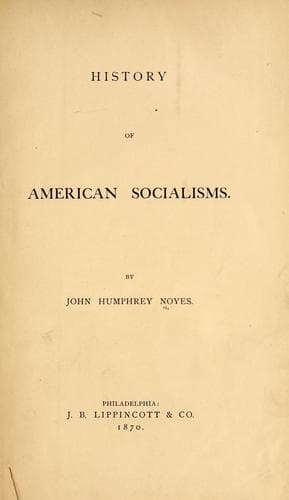
History of American SocialismsNoyes, John Humphrey
History
History of American Socialisms
Noyes, John Humphrey
Communism -- United States; Socialism -- United States
"I said the only result of the conversations which Dr. Channing had
was to initiate the little quarterly called _The Dial_; but they had a
further consequence in the creation of the society called the "Brook
Farm" in 1841. Many of these persons who had compared their notes
around in the libraries of each other upon speculative matters, became
impatient of speculation, and wished to put it into practice. Mr.
George Ripley, with some of his associates, established a society, of
which the principle was, that the members should be stockholders, and
that while some deposited money others should be allowed to give their
labor in different kinds as an equivalent for money. It contained very
many interesting and agreeable persons. Mr. Curtis of New York, and
his brother of English Oxford, were members of the family; from the
first also was Theodore Parker; Mr. Morton of Plymouth--engaged in the
fisheries--eccentric; he built a house upon the farm, and he and his
family continued in it till the end; Margaret Fuller, with her joyous
conversations and sympathies. Many persons gave character and
attractiveness to the place. The farm consisted of 200 acres, and
occupied some spot near Reedville camp of later years. In and around
it, whether as members, boarders, or visitors, were remarkable persons
for character, intellect and accomplishments. *** The Rev. Wm. H.
Channing, now of London, student of Socialism in France and England,
was a frequent sojourner here, and in perfect sympathy with the
experiment.***
"Brook Farm existed six or seven years, when the society broke up and
the farm was sold, and all parties came out with a loss; some had
spent on it the accumulations of years. At the moment all regarded it
as a failure; but I do not think that all so regard it now, but
probably as an important chapter in their experience, which has been
of life-long value. What knowledge has it not afforded them! What
personal power which the studies of character have given: what
accumulated culture many members owe to it; what mutual pleasure they
took of each other! A close union like that in a ship's cabin, of
persons in various conditions; clergymen, young collegians, merchants,
mechanics, farmers' sons and daughters, with men of rare opportunities
and culture."
Public-domain text, read in full here on John Shaqi.
Reviews
Reviews
No reviews yet
Be the first to share your thoughts on this work.
Elsewhere in the archive
Join the Discussion
Join the discussion
Sign in to leave a comment or review.
Sign InorCreate an account