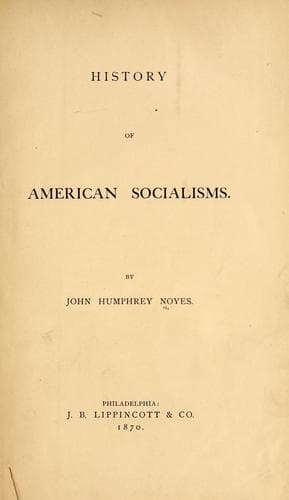
History of American SocialismsNoyes, John Humphrey
History
History of American Socialisms
Noyes, John Humphrey
Communism -- United States; Socialism -- United States
Mr. Emerson's lecture is doubtless reliable on the main point for
which we quote from it--the Unitarian and Channing-arian origin of
Brook Farm--but certainly superficial in its view of the substantial
character and final purpose of that Community. Brook Farm, though
American and Unitarian in its origin, became afterward the chief
representative and propagative organ of Fourierism, as we shall
ultimately show. The very blossom of the experiment, by which it
seeded the nation and perpetuated its species, was its periodical,
_The Harbinger_, and this belonged entirely to the Fourieristic period
of its career. Emerson dilates on _The Dial_, but does not allude to
_The Harbinger_. In thus ignoring the public function by which Brook
Farm was signally related to the great socialistic revival of 1843,
and to the whole of American Socialism, Emerson misses what we
conceive to be the main significance of the experiment, and indeed of
Unitarianism itself.
And here we may say, in passing, that this brilliant Community has a
right to complain that its story should have to be told by aliens.
Emerson, who was not a member of it, nor in sympathy with the
socialistic movement to which it abandoned itself, has volunteered a
lecture of reminiscences; and Hawthorne, who joined it only to jilt
it, has given the world a poetico-sneering romance about it; and that
is all the first-hand information we have, except what can be gleaned
from obsolete periodicals. George William Curtis, though he was a
member, coolly exclaims in _Harper's Magazine:_
"Strangely enough, Hawthorne is likely to be the chief future
authority upon 'the romantic episode' of Brook Farm. Those who had it
at heart more than he, whose faith and energy were all devoted to its
development, and many of whom have every ability to make a permanent
record, have never done so, and it is already so much a thing of the
past, that it will probably never be done."
In the name of history we ask, Why has not George William Curtis
himself made the permanent record? Why has not George Ripley taken the
story out of the mouths of the sneerers? Brook Farm might tell its own
story through him, for he _was_ Brook Farm. It was George Ripley who
took into his heart the inspiration of Dr. Channing, and went to work
like a hero to make a fact of it; while Emerson stood by smiling
incredulity. It was Ripley who put on his frock and carted manure, and
set Hawthorne shoveling, and did his best for years to keep work
going, that the Community might pay as well as play. It was no
"picnic" or "romantic episode" or chance meeting "in a ship's cabin"
to him. His whole soul was bent on making a _home_ of it. If a man's
first-born, in whom his heart is bound up, dies at six years old, that
does not turn the whole affair into a joke. There were others of the
same spirit, but Ripley was the center of them.
Public-domain text, read in full here on John Shaqi.
Reviews
Reviews
No reviews yet
Be the first to share your thoughts on this work.
Elsewhere in the archive
Join the Discussion
Join the discussion
Sign in to leave a comment or review.
Sign InorCreate an account