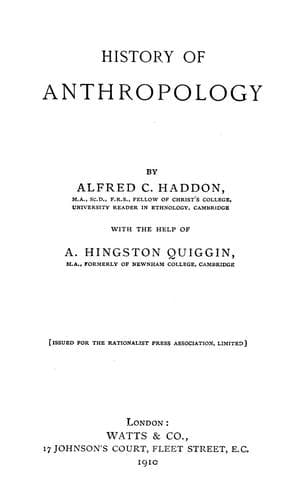
History of anthropologyHaddon, Alfred C. (Alfred Cort)
History
History of anthropology
Haddon, Alfred C. (Alfred Cort)
Anthropology -- History
The ferment provoked by the publication of Darwin’s _Origin of Species_
profoundly affected, as was natural, the nascent science of
Anthropology. At the meeting of the British Association in Nottingham in
1866 Dr. James Hunt read an address before the Anthropological
Department to show that “the recent application of Mr. Darwin’s
hypothesis of ‘natural selection’ to anthropology by some of Mr.
Darwin’s disciples is wholly unwarranted either by logic or by
facts.”[45] In this address he said that he still believed the deduction
he had made three years previously—“that there is as good reason for
classifying the negro as a distinct. species from the European as there
is for making the ass a distinct species from the zebra; and if, in
classification, we take intelligence into consideration, there is a far
greater difference between the negro and the European than between the
gorilla and chimpanzee.” He insisted that “anthropologists are bound to
take the totality of the characteristics of the different types of man
into consideration. “It is to be regretted, however,” Dr. Hunt
continues, “that there are many writers in Germany who have recently
written as though the question of man’s place in nature were settled”;
but he is delighted to find that “Professor Carl Vogt is doing all he
can to show the fallacy of the unity hypothesis.” He quotes Professor
Vogt as saying: “This much is certain, that each of these anthropoid
apes has its peculiar characters by which it approaches man.... If, in
the different regions of the globe, anthropoid apes may issue from
different stocks, we cannot see why these different stocks should be
denied further development into the human type, and that only one stock
should possess this privilege. The further we go back in history the
greater is the contrast between individual types, the more opposed are
the characters.”
Footnote 45:
_Anth. Rev._, iv., 320.
The controversies and discussions of this period were not confined to
those who had technical knowledge or scientifically trained minds. All
sorts of people joined in the fray, mainly because they fancied that the
new ideas were subversive of “revealed religion”; but it would serve no
useful purpose to recall the false statements and bitter expressions
that were bandied about. Some had merely a sentimental objection to the
doctrine of evolution; but at the present day most people would
subscribe to the declaration of Broca, who wrote: “Quant à moi, je
trouve plus de gloire à monter qu’à descendre et si j’admettais
l’intervention des impressions sentimentales dans les sciences, je
dirais que j’aimerais mieux être un singe perfectionné qu’un Adam
dégénéré.”[46]
Footnote 46:
_Mémoires d’Anthropologie_, iii., p. 146.
[Sidenote: =The Negro’s Place in Nature.=]
Public-domain text, read in full here on John Shaqi.
Reviews
Reviews
No reviews yet
Be the first to share your thoughts on this work.
Join the Discussion
Join the discussion
Sign in to leave a comment or review.
Sign InorCreate an account