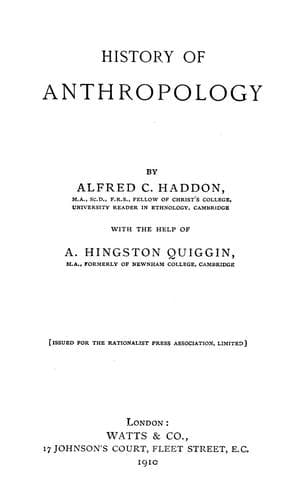
History of anthropologyHaddon, Alfred C. (Alfred Cort)
History
History of anthropology
Haddon, Alfred C. (Alfred Cort)
Anthropology -- History
Sir William Flower (1831-1899), a distinguished zoologist and
physical anthropologist, in 1885[74] adopted the old three-fold
classification:—I. Ethiopian, Negroid, or Melanian. _A._ African or
typical Negroes; _B._ Hottentots and Bushmen; _C._ Oceanic Negroes
or Melanesians; _D._ Negritos. II. Mongolian or Xanthous. _A._
Eskimo; _B._ Typical Mongolian (including the Mongolo-Altaic and the
Southern Mongolian groups); _C._ Malay; _D._ Brown Polynesians or
Malayo-Polynesians; _E._ American Indians (excluding the Eskimo).
III. Caucasian or “White.” _A._ Xanthochroi; _B._ Melanochroi. As
Flower himself says, this scheme of classification, “in its broad
outlines, scarcely differs from that proposed by Cuvier nearly sixty
years ago.... Still it can only be looked upon as an approximation.”
Although he places skin-colour first, he tacitly admits its
insufficiency as a main diagnostic character, and his three groups
coincide with a classification based on the nature of the hair.
Footnote 74:
_Journ. Anth. Inst._, xiv., pp. 378-393.
[Sidenote: =Deniker.=]
Among the later classifications a new tendency may be noted. The earlier
schemes aimed at producing a series of water-tight compartments into
which the races of the globe could be isolated. Further research,
however, encouraged the growing conviction that a pure race is
practically non-existent, and a different method had to be followed.
This is described by Deniker (p. 284): “Taking into account all the new
data of anthropological science, I endeavoured, as do the botanists, to
form natural groups by combining the different characters (colour of the
skin, nature of the hair, stature, form of the head, of the nose,
etc.).” This results in the formation of seventeen ethnic groups,
containing twenty-nine races, and these are ingeniously arranged (p.
289) in a two-dimensional grouping, to show their affinities, which is a
modification of his suggestive earlier scheme.[75]
Footnote 75:
_Bull. Soc. d’Anth._, 1889.
The “pigeon-hole” system of classification had, however, been
discredited in the fourth edition of Prichard’s _Natural History of
Man_, edited and enlarged by Edwin Norris (1855), since on p. 644 it is
stated:—
The different races of men are not distinguished from each other
by strongly-marked, uniform, and permanent distinctions, as are
the several species belonging to any given tribe of animals. All
the diversities which exist are variable, and pass into each
other by insensible gradations; and there is, moreover, scarcely
an instance in which the actual transition cannot be proved to
have taken place.
This is practically the same result at which Waitz arrived in 1863.
[Sidenote: =Keane.=]
Public-domain text, read in full here on John Shaqi.
Reviews
Reviews
No reviews yet
Be the first to share your thoughts on this work.
Elsewhere in the archive
Join the Discussion
Join the discussion
Sign in to leave a comment or review.
Sign InorCreate an account