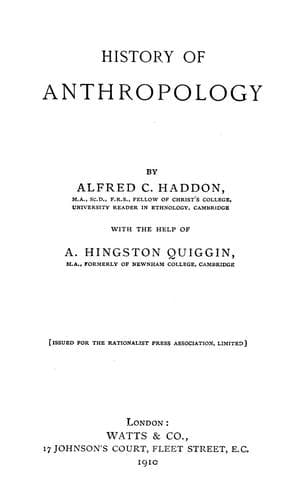
History of anthropologyHaddon, Alfred C. (Alfred Cort)
History
History of anthropology
Haddon, Alfred C. (Alfred Cort)
Anthropology -- History
Our knowledge is very imperfect concerning the movements of mankind.
Historical records give some information on the subject. A certain
amount has been gleaned from traditional sources, but doubtless much
more remains to be garnered. The spoils of the archæologist afford
important data, but there are immense tracts of country which are yet
totally unexplored, or very imperfectly investigated. All shiftings of
peoples are mainly controlled by climatic and geographical conditions;
but these are continually varying, and it is the business of the
geographer and geologist to indicate what these have probably been at
various periods since the appearance of man on this earth. It is not too
much to say that, when maps have been prepared which indicate these
various changes, great light will be thrown upon the early history of
mankind.
------------------------------------------------------------------------
CHAPTER VII.
ETHNOLOGY: ITS SCOPE AND SOURCES
[Sidenote: =Definition.=]
“ETHNOLOGY” is a term which is often loosely used as synonymous with
“Anthropology,” to cover the whole field of the science of man. It was
in this sense that it first came into prominence, being chosen by M. W.
F. Edwards as the title for the _Société ethnologique de Paris_, in
1839. The society was concerned with what we should now call
Anthropology; but it was more especially interested in the origins and
relationships of the historical races of Europe, which was the
etymological justification for its name. The English Ethnological
Society, established in 1843, imitated the French title, and did much to
fix the vague and general interpretation of the word. Unfortunately,
Professor Tylor, first and foremost of English ethnologists, seems
purposely to avoid the use of the word in his _Primitive Culture_, which
he refers to as “rational ethnography.” But, with the development of the
subject, its scope became gradually more defined, until it is now
generally restricted to the comparative and genetic study of human
culture and of man as a social animal.
The materials for the study of ethnology have been always with us, but
the study itself is of very recent development, and almost alone among
the sciences can reckon its founders among the living. Professor J. L.
Myres gives excellent reasons for this “late adolescence” in his opening
address at the meeting of the British Association at Winnipeg, 1909:—
Public-domain text, read in full here on John Shaqi.
Reviews
Reviews
No reviews yet
Be the first to share your thoughts on this work.
Elsewhere in the archive
Join the Discussion
Join the discussion
Sign in to leave a comment or review.
Sign InorCreate an account