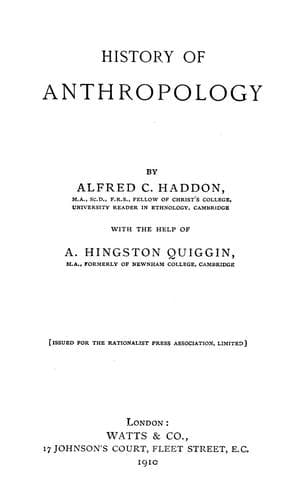
History of anthropologyHaddon, Alfred C. (Alfred Cort)
History
History of anthropology
Haddon, Alfred C. (Alfred Cort)
Anthropology -- History
Anthropology ... gathers its data from all longitudes, and
almost all latitudes, on this earth. It was necessary,
therefore, that the study of man should lag behind the rest of
the sciences, so long as any large masses of mankind remained
withdrawn from its view; and we have only to remember that
Australia and Africa were not even crossed at all—much less
explored—by white men, until within living memory, to realise
what this limitation means. In addition to this, modern Western
civilisation, when it did at last come into contact with
aboriginal peoples in new continents, too often came, like the
religion which it professed, bringing “not peace, but a sword.”
The customs and institutions of alien people have been viewed
too often, even by reasonable and good men, simply as “y^e
beastlie devices of y^e heathen,” and the pioneers of our
culture, perversely mindful only of the narrower creed, that “he
that is not with us is against us,” have set out to civilise
savages by wrecking the civilisation which they had (pp.
589-590).
[Sidenote: =Sources.=]
There are, as Professor Myres points out, two kinds of anthropologists:—
There is an anthropologist to whom we go for our facts: the
painful accurate observer of data, the storehouse of infinite
detail; sometimes himself the traveller and explorer, by cunning
speech or wiser silence opening the secrets of aboriginal
hearts; sometimes the middleman, the broker of traveller’s
winnings, insatiate after some new thing, unerring by instinct
rather than by experience, to detect false coin, to disinter the
pearl of great price.... To him we go for our facts....
And there is an anthropologist to whom we look for our light.
His learning may be fragmentary, as some men count learning; his
memory faulty; his inaccuracy beyond dispute; his inconsistency
the one consistent thing about him. But with shattered and
ricketty instruments he attains results; heedless of epicycles,
disrespectful to the equator, he bequeaths his paradoxes to be
demonstrated by another generation of men. He may not know, or
reason, perhaps; but he has learnt to see; and what he sees he
says (1908, p. 124).
[Sidenote: =Herodotus.=]
In the earliest times Herodotus may be cited as one of the most
distinguished names in the former of the two groups, and Lucretius in
the latter. The writings of Herodotus (_circa_ 480-425 B.C.) are a
veritable storehouse of information, from the highest civilisations down
to the veriest savagery, and his work has lost none of its freshness or
value through lapse of time. As a matter of fact, modern investigations
carried out in the areas treated of by him more frequently confirm and
exemplify than refute his statements.
[Sidenote: =Lucretius.=]
Public-domain text, read in full here on John Shaqi.
Reviews
Reviews
No reviews yet
Be the first to share your thoughts on this work.
Elsewhere in the archive
Join the Discussion
Join the discussion
Sign in to leave a comment or review.
Sign InorCreate an account