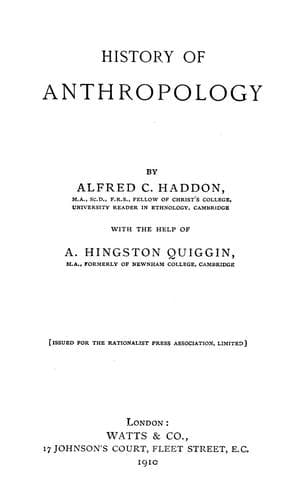
History of anthropologyHaddon, Alfred C. (Alfred Cort)
History
History of anthropology
Haddon, Alfred C. (Alfred Cort)
Anthropology -- History
These were the data on which the science of Ethnology, in its restricted
sense, was to be built. The earliest ethnologists utilised the material
mainly with a view to elucidating ethnic relationships, and to producing
systematic classifications of the various races of mankind. Later
workers such as Ratzel and Reclus produced systematic descriptions of
races, peoples, and areas. A third method was that of Tylor, the chief
exponent of Comparative Ethnology.
[Sidenote: =Systematic Works on Ethnology.=]
The earlier attempts at race classification were based merely on
physical characters, and are dealt with elsewhere (Chap. VI.). During
the eighteenth and early part of the nineteenth centuries geographical
discovery brought a mass of new facts to light, especially in the realm
of natural history; and in no branch of that science were the effects so
marked as in that of Anthropology.
The marshalling of a vast array of new observations and deductions
required a broad mind, wide knowledge, and shrewd reasoning powers.
These, together with a sound training in anatomy, an unusual
acquaintance with philology, and some eminence in psychology, produced
the monumental work of Prichard.
[Illustration:
J. C. PRICHARD.
]
[Sidenote: =Prichard.=]
James Cowles Prichard (1786-1848) showed, when a boy, a remarkable
aptness for foreign languages. He was never sent to school, but was
taught by various tutors, from whom he learnt Latin, Greek, French,
Italian, and Spanish. His father, a merchant, and member of the Society
of Friends, lived for a time in Bristol, and there the boy began his
practical study of anthropology, spending his time by the docks,
watching the foreign sailors, and chatting with them in their own
tongues. Later on he chose medicine for his profession, less on account
of any special liking for it than because it afforded him opportunities
for indulging his anthropological tastes. His first contribution to the
science was his thesis for the degree of Doctor of Medicine in the
University of Edinburgh, which was entitled _De generis humani
varietate_, published in 1813 in an expanded form as _Researches into
the Physical History of Man_. It was still further expanded in 1826, and
a five-volume edition was issued between 1836 and 1847. In 1843 appeared
another monumental work, _The Natural History of Man_, “comprising
inquiries into the modifying influence of physical and moral agencies on
the different tribes of the human family.”
Public-domain text, read in full here on John Shaqi.
Reviews
Reviews
No reviews yet
Be the first to share your thoughts on this work.
Elsewhere in the archive
Join the Discussion
Join the discussion
Sign in to leave a comment or review.
Sign InorCreate an account