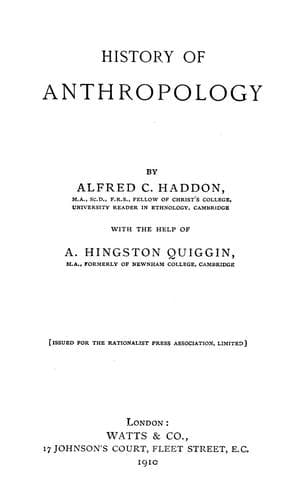
History of anthropologyHaddon, Alfred C. (Alfred Cort)
History
History of anthropology
Haddon, Alfred C. (Alfred Cort)
Anthropology -- History
In the writings of the earlier travellers (to mention but three
names)—Marco Polo, in Cathay (1254-1323), Ibn Batuta (1304-1377), in
Asia; and Joao de Barros (1496-1570), who was considered the greatest
authority on Portuguese, African, and Asiatic travels of his time—and in
the records of travels contained in collections such as those of Hakluyt
(1552-1616), Purchas (1577-1626), and Pinkerton (1758-1826), much
ethnological information can be sifted from among the marvellous tales.
Sometimes the marvellous tales themselves can, by ethnology, be
interpreted in fact, as when the “tailed men” of the Nicobars are found
to owe their origin to the tail-like method of wearing the
loin-cloth.[82] These were followed by the travellers and explorers of
the nineteenth century, who brought back a vast amount of new
information, both physical and cultural, from the lands they visited.
Among these the names of Admiral Byron, James Bruce, L. A. Bougainville,
Sir John Barrow, Captain Cook, de Lesseps, and Pallas may be mentioned.
Footnote 82:
E. H. Man, _Journ. Anth. Inst._, xv., p. 442.
Other sources of information were the works of the Jesuit missionaries
of the sixteenth to the eighteenth centuries, such as José d’Acosta
(1539-1600), J. F. Lafitau (1670-1740), and F. X. de Charlevoix
(1682-1761), who worked among the Canadian Indians, and M. Dobrizhoffer
(1717-1791).
Next come the missionaries of the nineteenth century, such as William
Ellis (1794-1872), who laboured in South Africa and Madagascar, but is
best known for his work in Polynesia; John Williams (1796-1839); George
Turner (1818-1891); W. Wyatt Gill (1828-1896), and others who also
worked in the Pacific. In Africa we may mention Bishop Callaway
(1817-1890) and David Livingstone (1813-1873). At the same time the
Roman Catholic missionary E. R. Huc (1813-1860) was working in China and
Tartary, while the Abbé Dubois (1770-1848) was laboriously investigating
the manners, customs, and ceremonies of the Hindus.
Besides the missionaries, we owe a deep debt of gratitude to the early
explorers and civil servants in all parts of the world, who have
provided, consciously or unconsciously, a vast amount of information
about the peoples among whom they travelled or over whom they ruled.
Scientific expeditions, even before these were undertaken in the
interests of anthropology, collected further material. Lastly come the
various anthropological expeditions, consisting of trained workers, who,
besides amassing fresh evidence, check, correct, or amplify the work of
earlier writers.
Public-domain text, read in full here on John Shaqi.
Reviews
Reviews
No reviews yet
Be the first to share your thoughts on this work.
Elsewhere in the archive
Join the Discussion
Join the discussion
Sign in to leave a comment or review.
Sign InorCreate an account