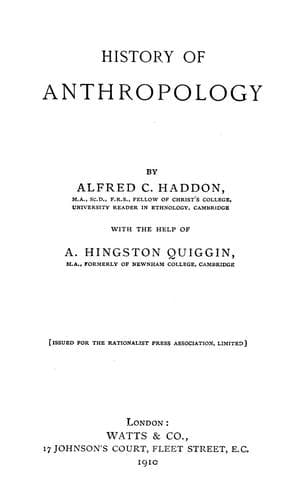
History of anthropologyHaddon, Alfred C. (Alfred Cort)
History
History of anthropology
Haddon, Alfred C. (Alfred Cort)
Anthropology -- History
The earlier of these generalisations were composed before the acceptance
of the theory of evolution, in the new light of which all biological
sciences had to start afresh, and all were written before the masses of
new material collected by ethnologists and archæologists, working in the
field, had brought so much fresh evidence to bear upon the whole
geographical and historical aspect of man that it was impossible “to see
the wood for the trees.” Thus the time for synthesis had arrived, and
with the hour came the man. A. H. Keane’s _Ethnology_ appeared in 1896,
to be followed by his _Man, past and present_ in 1899. J. Deniker’s _Les
races et les peuples de la terre_, together with the English
translation, appeared in the following year.
[Sidenote: =Ethnology and the Classics.=]
In summarising the sources from which the materials for the science of
ethnology are derived, stress must be laid on the contributions from
classic authors. No student can afford to neglect the histories, annals,
poems, and sacred books of the ancients, whether African, European, or
Asiatic. Professor J. L. Myres (1908) has pointed out that
anthropological investigations and speculations were already afoot in
the fifth century B.C. and before, and has outlined the ethnological
problems concerning man, his origin and relationships, and the questions
connected with his social life that interested and puzzled the ancient
Greek world. Not only Herodotus, but other writers, show that these
problems were thoroughly familiar to the Greeks. Long before Herodotus,
Hesiod refers to a standard scheme of archæology, in which Ages of Gold,
Silver, and Bronze succeed each other; primitive man is described as a
forest dweller growing no corn, but subsisting on acorns and beech mast;
Anaximander and Archelaus have suggestions to solve the mystery of man’s
origin, Anaximander taking an “almost Darwinian outlook”[83] of the
animal kingdom; Æschylus distinguishes the tribes of men by culture,
noting the differences in their dress and equipments, religious
observances and language.
Footnote 83:
This statement is criticised by E. E. Sikes in _Folk-Lore_, xx., 1909,
p. 424.
The chief value of the Greeks to the ethnologist is that they were
collectors of material. Some of their theories have been substantiated,
but they arrived at conclusions by deduction rather than by induction.
Thus in many ways anthropology owes a deep debt of gratitude to the
classics. It was not until recently that this debt began to be repaid.
Within the last twenty or thirty years there has been an increasing
recognition of the value of anthropological studies in the elucidation
of the classics; and this healthy movement is mainly associated with the
name of Professor William Ridgeway, of Cambridge, who devoted his
presidential address before the Royal Anthropological Institute, in
1909, to this subject.
Public-domain text, read in full here on John Shaqi.
Reviews
Reviews
No reviews yet
Be the first to share your thoughts on this work.
Elsewhere in the archive
Join the Discussion
Join the discussion
Sign in to leave a comment or review.
Sign InorCreate an account