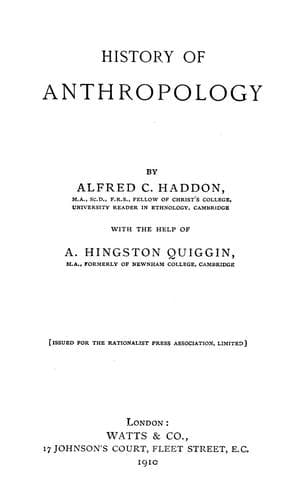
History of anthropologyHaddon, Alfred C. (Alfred Cort)
History
History of anthropology
Haddon, Alfred C. (Alfred Cort)
Anthropology -- History
In 1887 Professor Ridgeway proceeded to apply the comparative method to
Greek coins and weights in a paper called the “Homeric Talent: Its
Origin and Affinities.”[84] He there tried to show that the origin of
coined money among the Lydians, and its evolution by the Greeks and
Italians, entirely accorded with the evolution of primitive money from
the use of objects such as axes, ornaments, cattle, and so forth.
Footnote 84:
_Hellenic Journal_, VIII., p. 133; see also _The Origin of Metallic
Currency_, 1892.
One of the relations of Ethnology to other branches of the Humanities
which hitherto has received scant acknowledgment is its influence on the
course of Political Science. Professor J. L. Myres recently gave a
brilliant address on this subject at Winnipeg, in which he points out
how Bodin (1530-1596), Edward Grimstone (1615), Thomas Hobbes
(1588-1679), John Locke (1632-1704), Montesquieu (1689-1755), Rousseau
(1712-1778), Voltaire (1694-1778), Herder (1744-1803), and others,
referred to or utilised the accounts of natives by travellers to
illustrate their theories of statecraft.
------------------------------------------------------------------------
CHAPTER VIII.
THE HISTORY OF ARCHÆOLOGICAL DISCOVERY
[Sidenote: =Prehistoric Man.=]
DR. JOHNSON was not in advance of his time in anthropological matters.
While he was gibing at Lord Monboddo for his belief in man’s simian
affinities, he was also making a pronouncement on the subject of
prehistoric archæology that later discoveries were soon to disprove. Up
to his time history was content to start from the earliest written
documents, supplemented, now and then, by the evidence of coins and
inscriptions; and Dr. Johnson summed up contemporary opinion in his
statement, “All that is really known of the ancient state of Britain is
contained in a few pages. We can know no more than what old writers have
told us.”
But it was not long before it was recognised that there was other
evidence besides that of the “old writers,” evidence the nature of which
has been well described by Sir W. R. Wilde:—
We possess what cannot be falsified by the scribe, and, although
styled prehistoric, they are far more truthfully historical than
the writing that no doubt was largely interfered with, and
which, if old, now requires a gloss to interpret it. The grassy
mound or circle, the stones erected into a cromleach, the great
sepulchral mound, the cinerary urn, the stone weapon or tool,
the grain-rubber for triturating cereal food, the harpoon for
spearing fish, the copper and bronze tools and weapons, and the
gold ornaments of the most early tribes—all are now, in their
way, far more truthful than anything that could have been
committed to writing, even if there were letters in that day.
They are litanies in stone, dogmata in metal, and sermons
preaching from the grassy mound.[85]
Footnote 85:
Public-domain text, read in full here on John Shaqi.
Reviews
Reviews
No reviews yet
Be the first to share your thoughts on this work.
Elsewhere in the archive
Join the Discussion
Join the discussion
Sign in to leave a comment or review.
Sign InorCreate an account