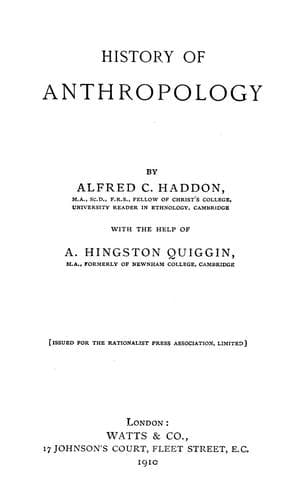
History of anthropologyHaddon, Alfred C. (Alfred Cort)
History
History of anthropology
Haddon, Alfred C. (Alfred Cort)
Anthropology -- History
Before chronicling the final triumph of the cave explorers in 1859, we
may briefly note another series of investigations which was being
carried on at the same time, and which also shared in the work of
throwing light on the shadowy figure of prehistoric man. This was the
excavation of crannogs and lake dwellings.
[Sidenote: =Irish Crannogs.=]
In 1839 Sir W. R. Wilde explored some of the Irish crannogs, or
semi-artificial islands, usually made of layers of stone, logs, sticks
(the so-called fascine dwellings), resting on _cluans_ or islets in the
Irish lakes. The first crannog explored was that at Lagore, famous in
ancient times as Loch Gobhair, near Dunshaughlin, co. Meath, and
mentioned in the _Annals of the Four Masters_ as having been plundered
in the ninth and tenth centuries. It was originally discovered by
accident. Some labourers, when clearing out a stream in the
neighbourhood, came across very numerous bones, and also a vast
collection of objects of all descriptions, warlike and domestic, made of
stone, bone, wood, bronze, and iron, and a few human remains.
The next crannog to be disclosed was one in Roughan Lake, near
Dungannon; and thereafter more and more came to light, until in 1857
forty-six had been recorded.
The crannog finds, and the depth of the deposits, indicated great age;
and Sir William Wilde at once recognised their significance in
determining the history of early human occupation in the island. This
evidence was strengthened by the discoveries shortly afterwards made in
Switzerland.
[Sidenote: =Swiss Pile-Dwellings.=]
Public-domain text, read in full here on John Shaqi.
Reviews
Reviews
No reviews yet
Be the first to share your thoughts on this work.
Elsewhere in the archive
Join the Discussion
Join the discussion
Sign in to leave a comment or review.
Sign InorCreate an account