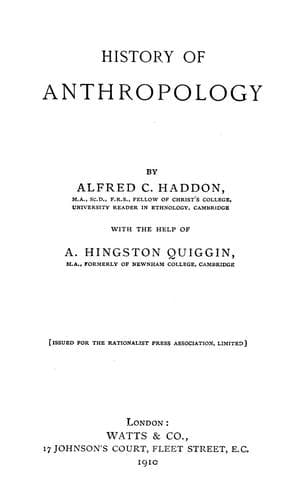
History of anthropologyHaddon, Alfred C. (Alfred Cort)
History
History of anthropology
Haddon, Alfred C. (Alfred Cort)
Anthropology -- History
So far but few traces of man’s presence in the caves had been detected,
and, when found, had generally been explained away as later intrusions,
though human occupations had been proved in Franconia, in the French
caves explored by MM. Tournai de Christol and Marcel de Serres in the
south of France in 1828, and later by the discoveries of Dr. Schmerling
in the caves of Liège about 1832.
[Sidenote: =Liège.=]
From the forty caves examined Dr. Schmerling found not only bones of
extinct animals, but also a few human bones, and a large number of bone
and flint implements and flakes, which he attributed to human
workmanship. Unfortunately, these discoveries were discredited both by
Dr. Buckland and Sir Charles Lyell, but have since been fully
substantiated by Dr. E. Dupont.[91]
Footnote 91:
_Les Temps Antéhist. en Belgique_, 1871.
[Sidenote: =Kent’s Cavern.=]
The most important of all the cave explorations in England is that of
Kent’s Cavern, Torquay. This cavern was known from time immemorial; but
the first investigation recorded was that of Mr. Northmore, of Cleeve,
Exeter, who visited it in 1824, in expectation of finding evidence of
the worship of Mithras.
The next year he returned there again, accompanied by the Rev. J.
MacEnery, the Roman Catholic chaplain at Tor Abbey, whose name will
always be honourably connected with the explorations of the cave. He was
not a geologist or a palæontologist, but to him fell the distinction of
discovering the first flint implement ever found in unmistakable
association with remains of extinct animals. On another occasion he
visited the cave together with Mr. Northmore and Dr. Buckland. “Nothing
remarkable was discovered that day, excepting the tooth of a rhinoceros
and a flint blade. This was the first instance of the occurrence of
British relics being noticed in this or, I believe, any other cave. Both
these relics it was my good fortune to find.”
He subsequently found many other flint implements, but Dr. Buckland was
not convinced that they occurred in an undisturbed area. He believed
that the ancient Britons had scooped out ovens in the stalagmite, and
that through them the flint implements had reached their position in the
cave earth. In 1846 the Torquay Natural History Society appointed a
committee of investigation, consisting of Pengelly and two others, who
confirmed MacEnery’s discovery of flint implements in conjunction with
extinct animals. Nevertheless, their evidence was not accepted. In
Pengelly’s words: “The scientific world ... told us that our statements
were impossible, and we simply responded with the remark that we had not
said they were possible, only that they were true.”[92]
Footnote 92:
_Kent’s Cavern_, 1876. Lecture delivered at Glasgow (1875).
[Sidenote: =Lake Dwellings.=]
Public-domain text, read in full here on John Shaqi.
Reviews
Reviews
No reviews yet
Be the first to share your thoughts on this work.
Elsewhere in the archive
Join the Discussion
Join the discussion
Sign in to leave a comment or review.
Sign InorCreate an account