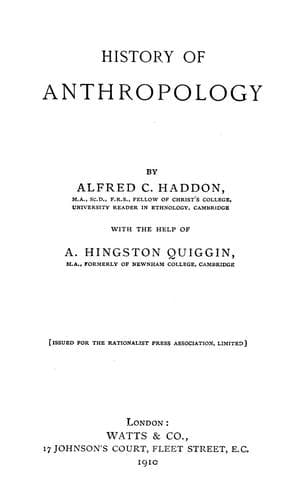
History of anthropologyHaddon, Alfred C. (Alfred Cort)
History
History of anthropology
Haddon, Alfred C. (Alfred Cort)
Anthropology -- History
“It was not until I had myself witnessed the conditions under which
these flint implements had been found at Brixham that I became fully
impressed with the validity of the doubts thrown upon the previously
prevailing opinions with respect to such remains in caves.”—Prestwich,
_Phil. Trans. Roy. Soc._, 1860.
It was not long before the same concession of the antiquity of man was
reached on the Continent.
[Sidenote: =Boucher de Perthes.=]
Boucher de Perthes, the son of a distinguished botanist, was early
attracted to the work of cave-exploration, and in 1805 and again in 1810
made discoveries of animal bones and of flint implements which he
recognised as the work of man. Later on, when extensive excavations for
fortifications and railroads were being carried on at Abbeville, he
found the same type of implement _in situ_, and in 1838 submitted some
of his discoveries and deductions to the Society of Emulation of
Abbeville, of which he was president. The next year he brought the same
evidence to Paris and showed his flints to several members of the
Institute. In 1847 he published a description of his finds. In 1855
Rigollot,[94] by his finds at Amiens, had confirmed the evidence
produced by Boucher de Perthes.
Footnote 94:
_Mémoire sur des Instruments en silex trouvés à St. Acheul près
Amiens._
In 1858 Hugh Falconer, the palæontologist, visited Abbeville to see the
collection of implements made by Boucher de Perthes, and “became
satisfied that there was a great deal of fair presumptive evidence in
favour of many of his speculations regarding the remote antiquity of
these industrial objects, and their association with animals now
extinct.”[95] Acting on Falconer’s suggestion, numerous geologists
visited Abbeville in the following year, including Sir Joseph Prestwich,
Sir John Evans, and Sir Charles Lyell; and Arthur J. Evans, then a boy
accompanying his father, had the good fortune to find one of the chipped
flints _in situ_. This established the horizon of the flints beyond
question, though there were still some who disputed the human
workmanship. The English archæologists and geologists however, had
already been convinced by the evidence of the Devonshire caves, and the
acceptance of “palæolithic man” on the Continent dates from their visit.
Footnote 95:
_Palæont. Mem._, ii., p. 597.
[Sidenote: =Subsequent Progress of Archæology.=]
Thenceforward archæology made greater progress abroad than in Great
Britain, mainly, perhaps, on account of the more numerous materials for
study.
[Sidenote: =France.=]
Public-domain text, read in full here on John Shaqi.
Reviews
Reviews
No reviews yet
Be the first to share your thoughts on this work.
Elsewhere in the archive
Join the Discussion
Join the discussion
Sign in to leave a comment or review.
Sign InorCreate an account