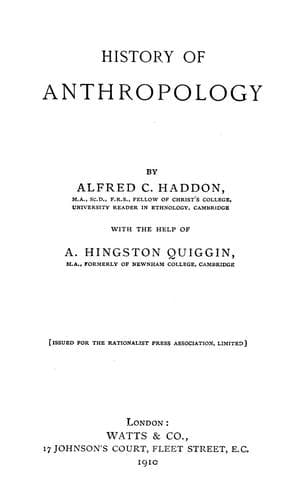
History of anthropologyHaddon, Alfred C. (Alfred Cort)
History
History of anthropology
Haddon, Alfred C. (Alfred Cort)
Anthropology -- History
To indicate the share that France has had and maintains in the
elucidation of Prehistoric Anthropology, we have only to mention the
work of É. Lartet with Mr. Henry Christy on the French caves of Aurignac
(1861) and Périgord (1864); A. J. L. Bertrand and G. Bonstetten on
dolmens (1864, 1865, and 1879); É. Rivière on the Mentone caves (1873);
and the numerous works of E. Chantre, especially with regard to the
Rhone basin. These and others prepared the way for the classic work of
G. de Mortillet (1883), whose masterly summary and methodical treatment
of the subject have been of great service to all subsequent workers.
While recognising the labours of other investigators, special mention
must be made of Judge E. Piette (1827-1906), whose excavations in the
cave of Mas d’Azil constitute a landmark in such studies. Professor E.
Cartailhac, Dr. Capitan, and l’Abbé H. Breuil have done further service
in their investigations in French caves; and the two latter, in their
beautiful memoir on the cave of Altamira in North Spain, have further
demonstrated the wonderful artistic sense and technique of the
cave-dwellers during the later phases of Palæolithic times.
In Britain we may note the names of J. Barnard Davis, J. Thurnam,
Rolleston, Sir Charles Lyell, Sir John Evans, Canon Greenwell, and
Professor Boyd Dawkins, whose standard works have largely helped to
mould the course of archæology in our own country.
In Germany, among the earlier writers may be mentioned C. Fuhlrott, L.
Lindenschmidt (1864-1881), J. A. Ecker (1865-1870), A. Lissauer, and,
above all, Rudolf Virchow, the author of numerous and valuable
contributions.
Elsewhere, G. Nicolucci studied prehistoric man in Italy, and during the
last thirty years the investigations of the illustrious Dr. Oskar
Montelius, of Stockholm, have been valued by all archæologists.
[Sidenote: =Tertiary Man.=]
Boucher de Perthes was the vindicator of Quaternary Man in France;
l’Abbé Bourgeois stands as the protagonist on behalf of Tertiary Man.
The first discovery of any traces of man’s existence during Tertiary
times was made in some sand and gravel quarries at Saint Prest, near
Chartres, by M. Desnoyers in 1863. He found various incised bones
bearing evidence of human workmanship, together with remains of _Elephas
meridionalis_ and _Rhinoceros leptorhinus_. But Sir Charles Lyell gave
it as his opinion, on examining the beds, that they were rather late
Quaternary than true Tertiary.
Public-domain text, read in full here on John Shaqi.
Reviews
Reviews
No reviews yet
Be the first to share your thoughts on this work.
Elsewhere in the archive
Join the Discussion
Join the discussion
Sign in to leave a comment or review.
Sign InorCreate an account