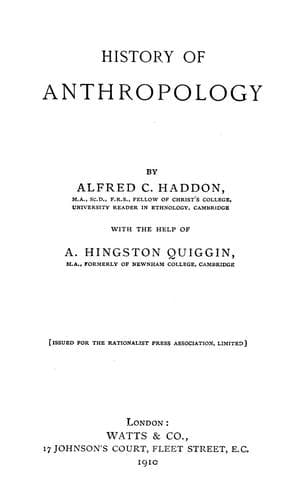
History of anthropologyHaddon, Alfred C. (Alfred Cort)
History
History of anthropology
Haddon, Alfred C. (Alfred Cort)
Anthropology -- History
The whole question was hotly debated at the Second Congress of
Archæology and Prehistoric Anthropology at Paris, in 1867, where l’Abbé
Bourgeois (1819-1878), Professor of Philosophy at Blois, exhibited his
famous flint implements from Miocene beds at Thenay, near Tours,
Loir-et-Cher. These were undoubtedly Miocene beds, but it was open to
doubt if the implements were of human origin, and, if so, if they were
found in undisturbed positions. At the _Congrès International
d’Anthropologie_ at Brussels in 1872 a committee of fifteen was formed
to discuss the problem, and opinions were divided. Nine authorities
recognised human workmanship (one changed his opinion later); four
denied it; one was favourable, but with reserve; and one was unable to
decide at all. De Mortillet believed that they had not been made by man
himself, but by a semi-human precursor of man, which he named
_Homosimius Bourgeoisii_.
Other finds of Tertiary man, those of the Upper Miocene, by C. Ribeiro,
at Otta, in the Tagus Valley, 1860; of Tardy in the same year, and of
Rames in 1877, in beds of the same horizon at Puy-courny, Auvergne; of
Capellini, in Pliocene beds of Monte Aperto, near Siena, and of Fritz
Noetling in lower Pliocene beds in Burma, 1894, have none of them been
received without question, and are still classed by most authorities, as
by Sir John Evans in 1870, and again in 1897, as “Not proven.”
[Sidenote: =Eoliths.=]
Closely connected with the question of Tertiary Man is the “raging
vortex of the eolith controversy,” as Sollas describes it. Benjamin
Harrison, of Ightham, Kent, first drew attention to these rude chipped
flints, which he found in the chalk plateau, and claimed to be of
pre-glacial age, and of human origin. Prestwich accepted this view;
Evans rejected it, and anthropologists are still divided into opposite
camps on the question. Eoliths have since been discovered in various
parts of the world, and have merely served to confirm the respective
points of view of the partisans on either side.
Sollas, after summing up all the evidence, says: “When experts are thus
at variance nothing remains for the layman but to preserve an open
mind.” These discussions as to the existence of quaternary and Tertiary
man would have been settled once for all had actual undoubted human
bones been found in any of the beds, but this was rarely the case, and
disputants had to rely almost entirely on questionable artifacts.
------------------------------------------------------------------------
CHAPTER IX.
TECHNOLOGY
Public-domain text, read in full here on John Shaqi.
Reviews
Reviews
No reviews yet
Be the first to share your thoughts on this work.
Elsewhere in the archive
Join the Discussion
Join the discussion
Sign in to leave a comment or review.
Sign InorCreate an account