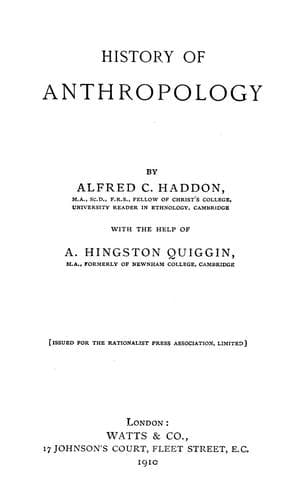
History of anthropologyHaddon, Alfred C. (Alfred Cort)
History
History of anthropology
Haddon, Alfred C. (Alfred Cort)
Anthropology -- History
Morgan was undoubtedly the greatest sociologist of the past century, and
in his monumental work (1871) laid a solid foundation for the study of
the family and kinship systems; he formulated a scheme of the evolution
of the family based on a study of the classificatory system of
relationships,[105] of which he was the discoverer. According to this
scheme, human society has advanced, through gradual evolution, from a
state of complete promiscuity to one characterised by monogamy. Dr.
Rivers[106] points out that “In recent years the scheme has encountered
much opposition.... The opponents of Morgan have made no attempt to
distinguish between different parts of his scheme, but, having shown
that certain of its features are unsatisfactory, they have condemned the
whole.” The greater part of Morgan’s work is, however, of lasting value.
Morgan based his conclusions on an enormous number of kinship terms
collected by himself and others from every available source. Dr. Rivers
has introduced[107] a new method of collecting similar data by means of
recording exhaustive genealogies from a limited area. In this way not
only can kinship terms be collected with accuracy, but a large number of
other sociological data are obtained with a readiness and precision not
hitherto possible. Indeed, it is no exaggeration to say that this method
is producing a revolution in the method of sociological field work.
Footnote 105:
W. H. R. Rivers, “On the Origin of the Classificatory System of
Relationships,” Anthropological Essays (Tylor Volume), 1907.
Footnote 106:
_Jour. Anth. Inst._, xxx., 1900, p. 74; _Sociological Rev._, 1910.
Footnote 107:
In the classificatory system most of the kin in the same generation
are grouped under one general term; _e.g._, all the males of the
grandfather’s generation are called by one term—another term includes
father, father’s brothers, father’s male cousins, mother’s sisters’
husbands, mother’s female cousins’ husbands, and so on.
In a later book (1878) Morgan summarised his earlier conclusions and
proposed a classification of culture consisting of a lower, middle, and
an upper Status of Savagery, a lower, middle, and an upper Status of
Barbarism, and the Status of Civilisation based upon certain inventions
and industries.
About this time various students wrote on marriage and the family, of
whom the foremost were Giraud Teulon (1867, 1874, 1884), H. Post (1875),
Letourneau (1888), Von Hellwald (1889), and others, the conclusions of
the earlier writers being summed up by Professor E. Westermarck in his
masterly _History of Human Marriage_ (1891); but much has been written
since that date on this subject of perennial interest.
Professor F. H. Giddings, in his _Principles of Sociology_, sums up in
the following words the trend of modern writers on ethnological
sociology:—
Public-domain text, read in full here on John Shaqi.
Reviews
Reviews
No reviews yet
Be the first to share your thoughts on this work.
Elsewhere in the archive
Join the Discussion
Join the discussion
Sign in to leave a comment or review.
Sign InorCreate an account