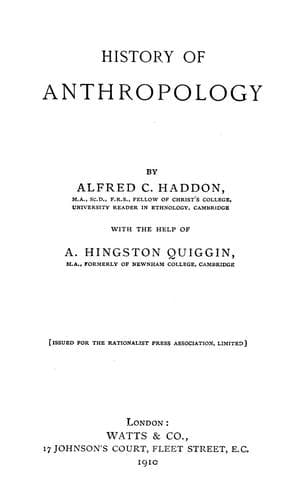
History of anthropologyHaddon, Alfred C. (Alfred Cort)
History
History of anthropology
Haddon, Alfred C. (Alfred Cort)
Anthropology -- History
Professor Ludwig Gumplowicz [1883] has tried to demonstrate that
the true elementary social phenomena are the conflicts,
amalgamations, and assimilations of heterogeneous ethnical
groups. M. Novicow [1893], generalising further, argues that
social evolution is essentially a progressive modification of
conflict by alliance, in the course of which conflict itself is
transformed from a physical into an intellectual struggle.
Professor De Greef [1886], looking at the question in a very
different way, finds the distinctive social fact in contract,
and measures social progress according to the displacement of
coercive authority by conscious argument. Mr. Gabriel Tarde
[1890], in an original and fascinating study, which has made an
enduring impress on both psychological and sociological thought,
argues that the primordial social fact is imitation, a
phenomenon antecedent to all mutual aid, division of labour, and
contract. Professor Émile Durkheim [1895], dissenting from the
conclusions of M. Tarde, undertakes to prove that the
characteristically social process, and therefore the ultimate
social phenomenon, is a coercion of every individual mind by
modes of action, thought, and feeling that are external to
itself (p. 14).
According to Giddings, the original and elementary subjective fact in
society is “the consciousness of kind.”
Social psychology offers a vast and fertile field which has been but
little worked, and there was needed an introduction to the subject which
should afford that general point of view which is the starting-point of
further studies. This Dr. W. McDougall has attempted in a recently
published little book.[108] His general conclusion is that the life of
societies is not merely the sum of the activities of individuals moved
by enlightened self-interest, or by intelligent desire for pleasure and
aversion from pain; but that the springs of all the complex activities
that make up the life of societies must be sought in the instincts and
in the other primary tendencies that are common to all men and are
deeply rooted in the remote ancestry of the race. Professor E. A. Ross,
of Wisconsin, simultaneously attacked the same subject, on the problems
of which he had previously written.[109]
[Sidenote: =Magic and Religion.=]
Public-domain text, read in full here on John Shaqi.
Reviews
Reviews
No reviews yet
Be the first to share your thoughts on this work.
Elsewhere in the archive
Join the Discussion
Join the discussion
Sign in to leave a comment or review.
Sign InorCreate an account