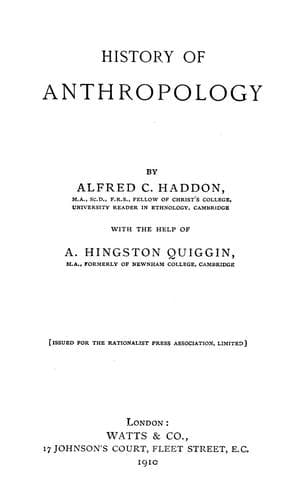
History of anthropologyHaddon, Alfred C. (Alfred Cort)
History
History of anthropology
Haddon, Alfred C. (Alfred Cort)
Anthropology -- History
To quote once more from Lang: “In the beginning of the [nineteenth]
century Germany turned her attention to mythology. In a pious kind of
spirit, Friedrich Creuzer [1771-1858] sought to find symbols of some
pure, early, and Oriental theosophy in the myths and mysteries of
Greece. The great Lobeck, in his _Aglaophamus_ (1829), brought back
common-sense, and made it the guide of his vast, his unequalled
learning. In a gentler and more genial spirit, C. Ottfried Müller
[1797-1840] laid the foundation of a truly scientific and historical
mythology. Neither of these writers had, like Alfred Maury [1857], much
knowledge of the myths and faiths of the lower races, but they often
seem on the point of anticipating the ethnological method.” (_L.c._, p.
23.)
[Sidenote: =Folklore.=]
The mythological aspect of the subject was illuminated by the researches
of the brothers Grimm (J. L. K., 1785-1863; W. K., 1786-1859), whose
collections of Märchen (1812-5) were found to contain Teutonic myths,
and by their resemblance to Norse, Greek, and Vedic mythology suggested
that in German folklore were remains of a common Indo-Germanic
tradition. This was the beginning of the intelligent study of Folklore.
Mannhardt (1865) and others investigated popular, and especially
peasant, customs and beliefs connected with agriculture and vegetation;
and showed that here, in what Christianity had reduced to superstition,
were to be found survivals of the religions that Christianity had
supplanted. Thenceforward the study of Folklore, and of the “lower
mythology” of beliefs, customs, and superstitions, gradually developed
into a science, which is now recognised as the valuable ally of
Anthropology. Meanwhile the anthropological signification of religion
was emerging from the mass of materials collected from all over the
globe. Anthropology established its universality, and made many attempts
to find a common factor, first in astral worship, then in Euhemerism
(Banier, 1738), Fetishism (De Brosses, 1709-1777), Nature-worship (Max
Müller, etc.), Ancestor-worship (Herbert Spencer, Lippert [1866], etc.),
and later in Totemism. These hypotheses were based on the erroneous
assumption that savage religion represented the primitive mode of
thought, out of which civilised religions had evolved. Later it was
realised that “The Australian black or the Andaman Islander is separated
by as many generations from the beginning of religion as his most
advanced contemporaries; and in these tens or hundreds of thousands of
years there has been constant change, growth, and decay—and decay is not
a simple return to the primal state. We can learn a great deal from the
lowest existing religions, but they cannot tell us what the beginning of
religion was, any more than the history of language can tell us what was
the first human speech.”[116]
Footnote 116:
G. F. Moore, “The Hist. of Religions in the Nineteenth Cent.,”
_Congress Arts and Sci., St. Louis_, 1904, p. 440.
Public-domain text, read in full here on John Shaqi.
Reviews
Reviews
No reviews yet
Be the first to share your thoughts on this work.
Elsewhere in the archive
Join the Discussion
Join the discussion
Sign in to leave a comment or review.
Sign InorCreate an account