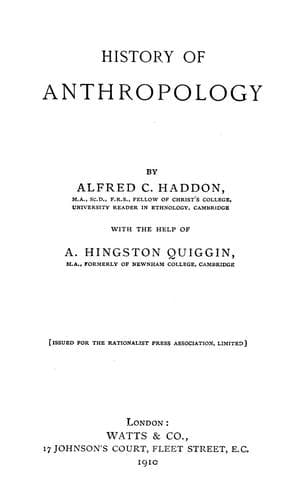
History of anthropologyHaddon, Alfred C. (Alfred Cort)
History
History of anthropology
Haddon, Alfred C. (Alfred Cort)
Anthropology -- History
As Andrew Lang (1887)[113] points out, in the sixth century B.C.
Xenophanes complained that the gods were credited with the worst crimes,
and other classical writers were shocked at the contradictions between
the conception and ritual worship of the same god. In ancient Egypt the
priests strove to shift the burden of absurdity and sacrilege from their
own deities. It taxed the ingenuity of pious Brahmans to explain the
myths which made Indra the slayer of a Brahman. Euhemerus (316 B.C.), in
his philosophical romance, _Sacra Historica_, in rationalising the
fables about the gods was regarded as an atheist. Certain writers like
Plutarch (60 A.D.) and Porphyry (270 A.D.) made the ancient deities
types of their own favourite doctrines, whatever these might happen to
be. The early Christians had a good case against the heathen. Eusebius,
in the _Præparatio Evangelica_, anticipating Andrew Lang himself,
“ridiculed, with a good deal of humour, the old theories which resolved
so many mythical heroes into the sun” (p. 20). “The physical
interpreters,” said Eusebius, “do not even agree in their physical
interpretations.” The light of the anthropological method had dawned on
Eusebius. Many centuries later Spencer, Master of Corpus Christi
College, Cambridge (1630-93), had no other scheme in his mind in his
erudite work on Hebrew ritual,[114] which he considered was but an
expurgated adaptation of heathen customs. Fontenelle[115] explained the
irrational element in myth as inherited from savagery.
Footnote 113:
1899 ed., pp. 6, 7.
Footnote 114:
_De Legibus Hebræorum Ritualibus_, 1732.
Footnote 115:
_De l’Origine des Fables: Œuvres_, Vol. III., 1758.
The revival of learning made scholars acquainted with the religions not
only of Greece and Rome, but of the nations with whom the Greeks and
Romans had come in contact—Egyptians, Semites, Persians, and Indians.
Travellers gave accounts of the religions they found in remote parts of
the world, and missionaries reported on beliefs and customs of many
nations. These were the sources from which were compiled the
comprehensive works on religion, from Alexander Ross, _View of All the
Religions in the World_, etc., 1652, to Dupuis, _Origine de tous les
cultes ou Religion Universelle_, 1794. All heathen religions were
believed to be based on sun and star worship.
New vistas were opened up by the writings of De Brosses (1760), who
investigated the beliefs of savage races and based all religion on
“Fetishism.”
Public-domain text, read in full here on John Shaqi.
Reviews
Reviews
No reviews yet
Be the first to share your thoughts on this work.
Elsewhere in the archive
Join the Discussion
Join the discussion
Sign in to leave a comment or review.
Sign InorCreate an account