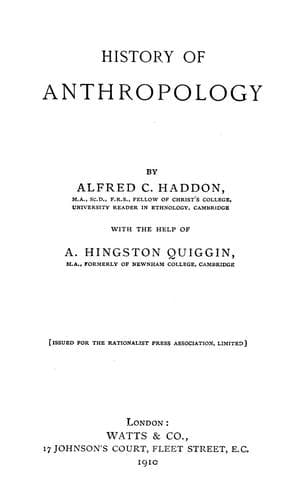
History of anthropologyHaddon, Alfred C. (Alfred Cort)
History
History of anthropology
Haddon, Alfred C. (Alfred Cort)
Anthropology -- History
The study of the myths of various peoples is receiving the attention of
numerous students, and in Germany certain ethnologists, such as
Ehrenreich, Foy,[118] and Frobenius,[119] find sun and moon gods in the
most unlikely places. There is, however, considerable danger that this
nature-mythology is being carried too far.
Footnote 118:
_Archiv für Religionswissenschaft_, x., 1907, etc.
Footnote 119:
“Die Weltanschauung der Naturvölker,” _Beitr. z. Volks-und
Völkerkunde_, vi., 1898; _Das Zeitalter des Sonnengottes_, i., 1904;
_The Childhood of Man_, 1909.
The origin of the moral idea has also been discussed from the
ethnological point of view, as Hobhouse (1906) and Westermarck (1906)
have exemplified in their great books.
Magic, religion, and morality have, as we have seen, especially of late
years, been regarded almost entirely from the anthropological
standpoint. But a new school of French students has arisen who maintain
that these are essentially social phenomena. The writings of Durkheim,
Hubert and Mauss[120] have initiated a new method of study which
promises to have far-reaching results.
Footnote 120:
The work of this school is mainly to be found in _L’Année
sociologique_ (1898).
------------------------------------------------------------------------
CHAPTER XI.
LINGUISTICS
LINGUISTICS as a department of Anthropology may be regarded from many
points of view. To the evolutionist language forms one of the tests
dividing the Hominidæ from the other anthropoids; the somatologist is
interested in correlating the phonetic system with the structure of the
organs connected with the mechanism of speech; and the ethnologist
studies language for the evidence it affords of ethnic affinity or
social contact, or as a means of determining the grade of culture to
which a particular people has attained, or, again, as a reflection of
their character or psychology. The linguistic classifications of
Gallatin, Humboldt, and Müller are referred to later.
[Sidenote: =The Aryan Controversy.=]
The connection between linguistics and anthropology assumed its greatest
importance in the middle of the nineteenth century, when the discoveries
and theories of philologists were adopted wholesale to explain the
problems of European ethnology, and the Aryan controversy became the
_locus_ of disturbance throughout the Continent. “No other scientific
question, with the exception, perhaps, of the doctrine of evolution, was
ever so bitterly discussed or so infernally confounded at the hands of
Chauvinistic or otherwise biassed writers.”[121]
Footnote 121:
Ripley, 1899, p. 453.
In 1786 Sir William Jones had pointed out the relationship between
Sanskrit, Greek, Latin, German, and Celtic, and suggested a common
parentage, which was confirmed by Bopp in 1835. Unfortunately, a
primitive unity of speech was held to imply a primitive unity of race.
Public-domain text, read in full here on John Shaqi.
Reviews
Reviews
No reviews yet
Be the first to share your thoughts on this work.
Elsewhere in the archive
Join the Discussion
Join the discussion
Sign in to leave a comment or review.
Sign InorCreate an account