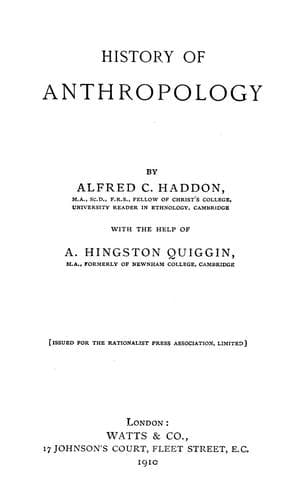
History of anthropologyHaddon, Alfred C. (Alfred Cort)
History
History of anthropology
Haddon, Alfred C. (Alfred Cort)
Anthropology -- History
Among the ethnological papers read at the meeting of the British
Association in 1847 was one “On the Results of the recent Egyptian
Researches in reference to Asiatic and African Ethnology, and the
Classification of Languages,” in which Baron Bunsen sought to show that
the whole of mankind could be classified according to language. In fact,
it was taken for granted in 1847 that the study of comparative philology
would be in future the only safe foundation for the study of
anthropology.[122] The spread of this fallacy is usually attributed to
Max Müller, whose charm of style and high reputation as a Sanskrit
scholar did much to popularise the new science of philology. He invented
the term “Aryan,” which in itself contains two erroneous assumptions—one
linguistic, that the Indo-Iranian group of languages is older than its
relatives; and the other geographical, that its “cradle” was in ancient
Ariana, in Central Asia. Moreover, in his lectures he not only spoke of
an Aryan language, but of an “Aryan race.” He is credited with having
made “heroic reparation” for these errors when he wrote later: “To me an
ethnologist who speaks of an Aryan race, Aryan blood, Aryan eyes and
hair, is as great a sinner as a linguist who speaks of a dolichocephalic
dictionary or a brachycephalic grammar. It is worse than a Babylonian
confusion of tongues—it is downright theft.” But, as he pointed
out,[123] he himself never shared the misconception that he was accused
of launching on the world. He admits that he was not entirely without
blame, as he allowed himself occasionally the freedom to speak of the
Aryan or the Semitic race, meaning the people who spoke Aryan or Semitic
languages; but as early as 1853 he had protested against the intrusion
of linguistics into ethnology, and
called, if not for a complete divorce, at least for a judicial
separation between the study of Philology and the study of
Ethnology.... The phonologist should collect his evidence,
arrange his classes, divide and combine as if no Blumenbach had
ever looked at skulls, as if no Camper had ever measured facial
angles, as if no Owen had ever examined the base of a cranium.
His evidence is the evidence of language, and nothing else; this
he must follow, even though in the teeth of history, physical or
political.... There ought to be no compromise between
ethnological and phonological science. It is only by stating the
glaring contradictions between the two that truth can be
elicited.[124]
Footnote 122:
_Rep. Brit. Assoc._ (Cardiff), 1891, p. 787.
Footnote 123:
_Rep. Brit. Assoc._ (Cardiff), 1891, p. 787.
Footnote 124:
_Rep. Brit. Assoc._ (Cardiff), 1891, p. 787.
The protest was in vain. The belief in an “Aryan race” became an
accepted fact both in linguistics and in ethnology, and its influence
vitiates the work of many anthropologists even at the present day.
Public-domain text, read in full here on John Shaqi.
Reviews
Reviews
No reviews yet
Be the first to share your thoughts on this work.
Elsewhere in the archive
Join the Discussion
Join the discussion
Sign in to leave a comment or review.
Sign InorCreate an account