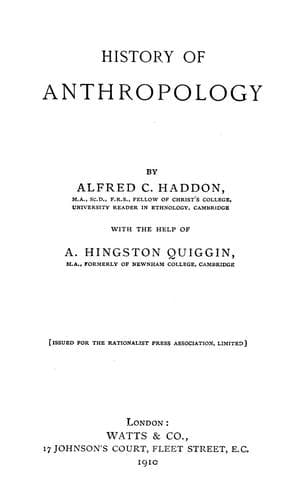
History of anthropologyHaddon, Alfred C. (Alfred Cort)
History
History of anthropology
Haddon, Alfred C. (Alfred Cort)
Anthropology -- History
Physical anthropology has had very numerous devotees, who have
approached the subject mainly from the point of view of small anatomical
variations; but even at the present day the significance of many of the
details is not understood, and very little advance has been made
concerning the criteria of racial anatomy. We have yet to discover how
adequately to describe or gauge the essential anatomical distinctions
between races and peoples. This problem is complicated by our ignorance
of the stability of physical characters, and of how far or how speedily
they are affected by change of environment. At the present time the
effects of miscegenation and of environment afford fruitful fields for
research. The imperfection of the geological record is answerable for
the relatively slow progress that has been made in tracing the evolution
of man as an animal.
Whereas the structural characters of man have been studied by trained
scientific men, the history of man from a cultural point of view has
mainly been investigated by literary men, who have approached the
subject from various sides, and, from lack of experience in the field or
by virtue of their natural reliance upon documentary evidence, have
often not been sufficiently critical regarding their authorities. The
comparative method has yielded most valuable results, but it is liable
to lead the unwary into mistakes. To employ biological terms, analogy is
apt to be mistaken for homology, since customs or beliefs (which, it
must be remembered, are in the vast majority of cases extremely
imperfectly recorded) may have a superficial resemblance. If all the
facts were known, they might be found to have had a very different
origin or significance. Comparisons made within a given area or among
cognate peoples have a greater value than those drawn from various parts
of the world. What is most needed at the present day is intensive study
of limited areas; the studies already so made have proved most fruitful.
Although we know a good deal about many forms of social organisation, we
find that in very few cases is the knowledge sufficiently precise to
explain them, owing to the fact that the data were not collected by
adequately trained observers. In other words, cultural anthropology has
been too much at the mercy of students who have not received a
sufficiently rigorous training.
The objects made by man have only recently been subjected to critical
study. In this the archæologists have been in advance of the
ethnologists. The distribution of objects and its significance have been
studied more in Germany than elsewhere, and already afford promising
results.
Anthropology is slowly becoming a coherent and organised science. The
chief danger to which it is liable is that its fascination and
popularity, touching as it does every department of human thought and
activity, tend to premature generalisations.
Public-domain text, read in full here on John Shaqi.
Reviews
Reviews
No reviews yet
Be the first to share your thoughts on this work.
Elsewhere in the archive
Join the Discussion
Join the discussion
Sign in to leave a comment or review.
Sign InorCreate an account