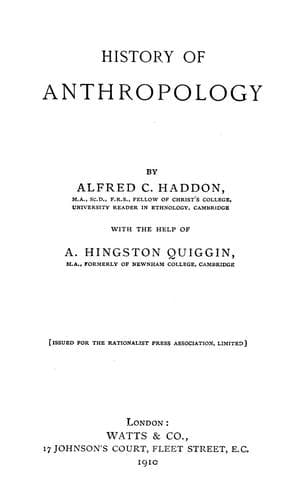
History of anthropologyHaddon, Alfred C. (Alfred Cort)
History
History of anthropology
Haddon, Alfred C. (Alfred Cort)
Anthropology -- History
Between 1857 and 1861 appeared Buckle’s _History of Civilisation_, in
which the influence of environment on mankind is strongly emphasised.
“To one of these four classes (Climate, Food, Soil, and the General
Aspect of Nature) may be referred all the external phenomena by which
Man has been permanently affected.”[129] The recognition of the
environmental influence has long been a characteristic of the French
school. Ripley (1900, p. 4) points out that, wherever the choice lies
between heredity and environment, the French almost always prefer the
latter as the explanation of the phenomenon. This is seen from the time
of Bodin (1530-1596) and Montesquieu (1689-1755), with their objective
explanations of philosophy, and Cuvier, who traced the close
relationship between philosophy and geological formation, to Turquan
(1896), who mapped out the awards made by the Paris Salon, showing the
coincidence of the birth-place of the artists with the fertile river
basins.
Footnote 129:
_L.c._, chap. ii.
[Sidenote: =Ratzel. Reclus.=]
In Germany the exponents of these theories were Cotta and Kohl, and
later Peschel, Kirchhoff, Bastian, and Gerland; but the greatest name of
all is that of Friedrich Ratzel (1844-1904), who has written the
standard work on _Anthropo-Geographie_ (1882-91). Another monumental
work is that by Élisée Reclus (1820-1905), _Nouvelle Géographie
Universelle_ (1879-1894).
[Sidenote: =Le Play.=]
A great stimulus to the development of ethnological sociology was given
by the school of Le Play in France, the concrete application of whose
theories was worked out by Demolins and others, and published in _La
Science Sociale_ and separate works. It is the essential procedure of
the followers of this school, in their studies in descriptive sociology,
to begin with the environment, and to trace its effects upon the
occupation of the people, their sociology, and so forth. The method is
an extremely suggestive one, and has led to many brilliant
generalisations. The danger consists in theorising from imperfect data,
and there is a tendency to attribute certain social conditions directly
to the influences of environment and occupation, where a wider knowledge
of ethnology would show that these or analogous social conditions
obtained in other places where they were not produced by the causes
suggested.
------------------------------------------------------------------------
_RETROSPECT_
ON taking a brief final survey of the history of anthropology, one is
struck by the fact that, owing to the tendency of students to limit
their attention to one of the varied subjects which are grouped under
the term Anthropology, the progress of the science has been very
irregular.
Public-domain text, read in full here on John Shaqi.
Reviews
Reviews
No reviews yet
Be the first to share your thoughts on this work.
Elsewhere in the archive
Join the Discussion
Join the discussion
Sign in to leave a comment or review.
Sign InorCreate an account