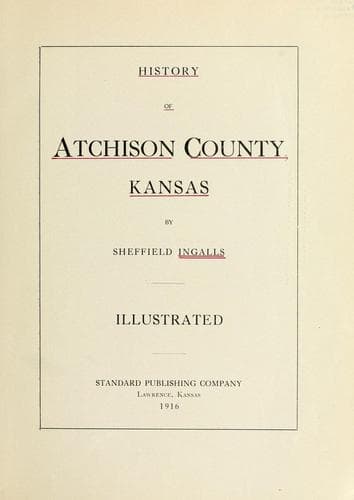
History of Atchison County, KansasIngalls, Sheffield
History
History of Atchison County, Kansas
Ingalls, Sheffield
Atchison County (Kan.) -- Biography; Atchison County (Kan.) -- History
horse a short distance, when finding a crowd gathering for his capture,
he struck him a blow on the head with his pistol and fled.”
Cleveland continued his exploits for a number of months after this, but
was finally captured in one of the southern counties where he was
attempting to let himself down the side of a ravine. He was shot by a
soldier from above, and the ball entered his arm and passed through his
body. He was buried in St. Joseph. Mo., and a marble head stone over his
grave bears the following inscription, placed there by his widow: “One
hero less on earth, one angel more in heaven.”
As the direct result of the operations of Cleveland and his gang, the
spirit of lawlessness grew and the people finally “took the law into
their own hands.” Perhaps the best account of the lynchings that
followed was given by Hon. Mont. Cochran March 17, 1902, at the time a
Congressman from Missouri, but formerly a leading citizen and county
attorney of Atchison. Mr. Cochran said:
“The thieves who fell victims to Judge Lynch, while not known as
Cleveland’s gang, operated extensively throughout the period of
lawlessness in which no effort whatever was made to bring the outlaws to
justice. After the Cleveland gang had been effectively broken up, these
depredatory scoundrels continued their operations. Their last crime, and
the one for which they were gibbeted, was the attempted robbery of an
old man named Kelsey. He had received at Ft. Leavenworth $1,500 on a
Government contract, and, upon returning home by the way of Atchison, he
deposited it in Hetherington’s bank. The thieves went to his house at
night and demanded the money. Of course, he could not produce it. They
tortured the old man and his wife alternately for hours, and when after
the departure of the thieves, the neighbors were called in, Kelsey and
his wife were nearer dead than alive. The next morning hundreds of their
neighbors, armed to the teeth, swarmed into Atchison. In Third street,
north of Commercial, was a little log building, which had been the home
of an early settler, in which was a gunsmith’s shop. Three or four of
the farmers went there to have their fire arms put in order. When they
came out one of them had a revolver in his hand. Two fellows standing
by, seeing the farmers approaching, dived into an alley and started
westward at lightning speed. The farmers pursued and at the house of a
notorious character, known as Aunt Betsey, the fugitives were run to
cover. The house was surrounded and they were captured. One of them was
Sterling, the fiddler and pianist of the bagnio. Other arrests followed
until five were in durance. Then ensued probably the most extraordinary
proceeding known to the annals of Judge Lynch. The mob took possession
of the jail and the court house and for a week held them. The prisoners
were tried one by one. Sterling was convicted and executed. An elm tree,
standing on the banks of White Clay creek, in the southwest quarter of
Public-domain text, read in full here on John Shaqi.
Reviews
Reviews
No reviews yet
Be the first to share your thoughts on this work.
Elsewhere in the archive
Join the Discussion
Join the discussion
Sign in to leave a comment or review.
Sign InorCreate an account