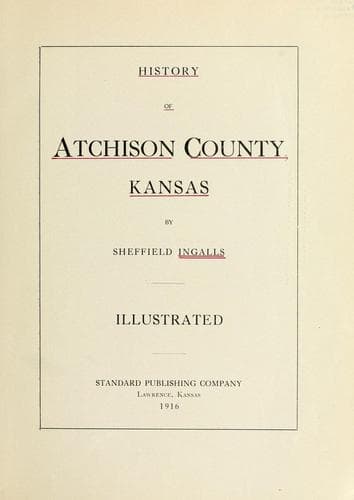
History of Atchison County, KansasIngalls, Sheffield
History
History of Atchison County, Kansas
Ingalls, Sheffield
Atchison County (Kan.) -- Biography; Atchison County (Kan.) -- History
the town, was admirably suited to the purpose. When the wagon, bearing
Sterling to his doom reached the ground the whole town was in
attendance. A range of hills to the south swarmed with women. Asa
Barnes, a prominent farmer, a man of iron resolution and unswerving
honesty, was the leader of the mob. With clinched teeth and blanched
face he ordered Sterling to take his place on the seat of the wagon,
and, while the desperado was as game as a peacock, he promptly obeyed.
Standing on the wagon seat Sterling took off his hat, banged it down and
placing his foot on it, shook his clenched hand at the sea of upturned
faces, and with a volley of imprecations, said: ‘I am the best d—d man
that ever walked the earth and if you will drop me down and give me a
gun, I will fight any ten of you.’ Sandy Corbin, a great bluffer, who
bore but little better reputation than the man with the noose on his
neck, pretended that he wanted to fight Sterling single-handed. Nobody
else paid any attention to Sterling’s ravings, and in a twinkling he was
swung into eternity. The next day two others, a man named Brewer, a
soldier at home on a furlough, and a young fellow known as Pony, met the
same fate. There was much sympathy for Pony. He was a drunkard and all
his delinquencies were attributed to this weakness. Just as they were
ready to swing him up, two or three members of the mob told him that if
he would give information as to others implicated, but who had not been
arrested, they would save him. His reply was: ‘I went into this thing as
a man and I will die as a man.’ There was a stir among those nearest the
wagon and it was discovered that an effort was being made to save the
boy from death. The traces were cut and the horses led away. The effort
failed. Fifty men seized the wagon and dragged it away. The fourth to
suffer the vengeance of the mob was an old gray-haired man named Moody.
At the trial he strongly protested his innocence, and promised, if given
a respite of twenty-four hours, he would prove an alibi. This was
granted, but the witnesses were not forthcoming and the next day the old
man was put to death. A priest visited him in jail, which was constantly
surrounded day and night, and when he came out after administering the
rights of the church to the doomed man, it was remarked by those who saw
him that the priest was as pale as a ghost. The report gained currency
that when asked if Moody was innocent, he refused to answer yea or nay,
and, although it had not then developed that Moody could not produce the
witnesses he promised, the conduct of the priest was taken as proof that
Moody was guilty. During the week in which these extraordinary
proceedings took place, the mob was in undisputed control of the court
house and jail. Judge Lynch was perched upon the wool sack and a jury of
twelve men, who had qualified under oath, in the usual form, occupied
the jury box. Not the slightest effort at concealment was made by those
who led or those who followed.
Public-domain text, read in full here on John Shaqi.
Reviews
Reviews
No reviews yet
Be the first to share your thoughts on this work.
Elsewhere in the archive
Join the Discussion
Join the discussion
Sign in to leave a comment or review.
Sign InorCreate an account