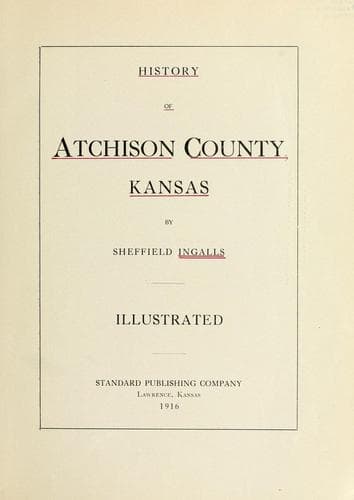
History of Atchison County, KansasIngalls, Sheffield
History
History of Atchison County, Kansas
Ingalls, Sheffield
Atchison County (Kan.) -- Biography; Atchison County (Kan.) -- History
The Second regiment, Kansas colored infantry, was organized in June,
1863, at Ft. Smith, Ark., and among its line officers was First Lieut.
John M. Cain, of Atchison. It conducted itself with conspicuous bravery
with the army of the frontier, and during the brief occupation of
Camden, Ark., by General Steele’s forces, this regiment was employed on
picket and forage duty. It showed conspicuous bravery around Poison
Springs and Mark’s Mills, and under the able command of Col. Samuel J.
Crawford, who subsequently became governor of Kansas, it won for itself
an enviable name among the regiments from Kansas, who participated in
the Civil war. This regiment was finally discharged from the services at
Leavenworth November 27, 1865, after having proved to the Nation the
fidelity of the colored soldier.
It was in September, 1864, that General Sterling Price created great
consternation by an attempted invasion of Kansas, which ended in his
defeat on the border by the Union forces, aided by the Kansas State
militia. At the time Price started north in his march through Arkansas
and Missouri. Maj. Gen. Samuel R. Curtis commanded the Department of
Kansas, which included Nebraska, Colorado and Indian Territory, in
addition to Kansas. General Curtis had about 4,500 men, all of whom had
been employed in protecting the frontiers of Kansas and Colorado, and
the overland mail route. At this time General Curtis was near Ft.
Kearney, operating against the Indians. On receipt of word announcing
the movements of General Price, General Curtis was recalled and reached
Kansas in September. A few days later he received word that 3,000 rebels
were marching on Ft. Scott, and advised Governor Carney to call the
militia into service. At this time George W. Deitzler was major-general
of the State militia; John T. Norton was assistant adjutant-general; R.
A. Randlett, assistant quartermaster; Samuel S. Atwood, assistant
quartermaster; Charles Chadwick, George T. Robinson, Lewis T. Welmorth,
John J. Ingalls, Thomas White, Elijah G. Moore, H. Stein, and John A.
Leffkler were all majors. Constant reports of a conflicting nature were
spread from day to day, regarding the movements of General Price, but
the first point to be attacked was Pilot Knob, the engagement commencing
September 27 and lasting all day. General Ewing put up a vigorous
defense, with a force of about 1,000 men, while the militia commanders
in Kansas made preparations for further resistance to the invasion of
Price. Meanwhile General Price continued to make headway, and on the
fourth of October an order was issued forbidding the transit of boats
below Kansas City. When it was discovered that the rebels under Price
had not been seriously checked in their movement westward, further
efforts were made by General Curtis to prevail upon Governor Kearney to
call out the militia, which the Governor seemed disinclined to do.
Finally, on October 9, 1864, Major General Deitzler issued an order for
Public-domain text, read in full here on John Shaqi.
Reviews
Reviews
No reviews yet
Be the first to share your thoughts on this work.
Elsewhere in the archive
Join the Discussion
Join the discussion
Sign in to leave a comment or review.
Sign InorCreate an account