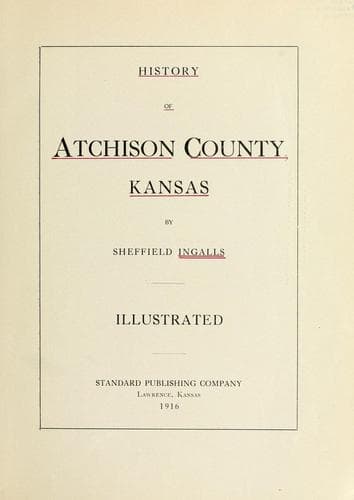
History of Atchison County, KansasIngalls, Sheffield
History
History of Atchison County, Kansas
Ingalls, Sheffield
Atchison County (Kan.) -- Biography; Atchison County (Kan.) -- History
At the time Atchison county was settled, railroad transportation by
steam was not a new thing, although it was in its primitive stages.
Navigation of the inland waterways had reached rather a high state of
development, and the matter of transportation then was just as essential
to the purposes of civilization as in this day of the railroad and the
automobile, but it was many years before the steam railroads made the
steamboat traffic of the Mississippi and Missouri rivers obsolete. The
tremendous subsidies granted by the Government in later years for
railroad building, however, and the splendid opportunity for piling up
wealth in the projection of new railroads and the operation of them,
without Governmental restrictions, together with the advantage of
speedier transportation facilities, completely overshadowed the
steamboat business, and as a result, our great inland waterway system
has grown into practical disuse. Shortly after Atchison county was
organized, and the city of Atchison laid out, agitation was started for
railroad connections with the East. One of the first ordinances passed
by the city council in 1858 provided for an election to submit a
proposition to take $100,000.00 of stock in railroad. At that time the
only means of communication to the outside world Atchison had was by
steamboats to St. Louis. It was in October, 1855, that George M.
Million, Lewis Burnes, D. D. Burnes, James N. Burnes and Calvin F.
Burnes commenced the operation of a ferry across the Missouri river.
Their dock on the Kansas side was at the foot of Atchison street. Their
charter was secured from the legislature under the terms of which a bond
of $1,000.00 was required to insure the faithful performance of their
operations. Although there was no public utilities commission in Kansas
in 1855, the legislature took upon itself the task of fixing the rates
to be charged by the ferry owners, in order that the public would not be
robbed. They were as follows:
Two-horse wagon, or wagon and one yoke of oxen (loaded) $1.00
Two-horse wagon, or wagon and one yoke of oxen (unloaded) .75
One additional pair of horses or oxen .25
Loose cattle or oxen, per head .10
Sheep and hogs, per head .05
Man and horse .25
Foot passengers .10
One horse and buggy or other vehicle .50
Two horse buggy or carriage .75
The original promoters operated the ferry but a short time, and early in
the following year, they disposed of their interests to Dr. William L.
Challiss, and his brother, Luther C. Challiss, and Willis E. Gaylord,
and the ferry, under Dr. Challiss, and subsequent owners, continued in
operation until 1875, when the present bridge was built.
Public-domain text, read in full here on John Shaqi.
Reviews
Reviews
No reviews yet
Be the first to share your thoughts on this work.
Elsewhere in the archive
Join the Discussion
Join the discussion
Sign in to leave a comment or review.
Sign InorCreate an account