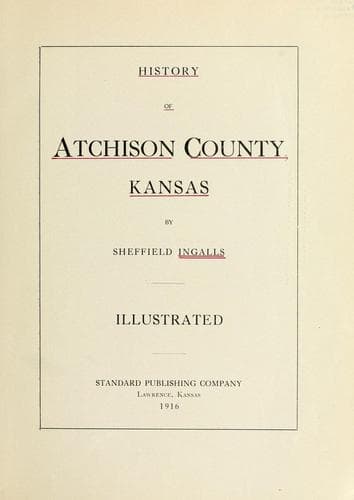
History of Atchison County, KansasIngalls, Sheffield
History
History of Atchison County, Kansas
Ingalls, Sheffield
Atchison County (Kan.) -- Biography; Atchison County (Kan.) -- History
While there was considerable freighting out of Atchison to the West
following the opening of the Territory, overland staging did not reach
its height until 1861. The era of overland staging from the Missouri
river to the Pacific coast lasted altogether about eight years. The
first great overland staging enterprise started in 1858, on what is
known as the Southern or Butterfield route. This route ran from St.
Louis and Memphis, Tenn., intersecting at Ft. Smith, Ark. After being in
operation for nearly three years, the route was succeeded by a daily
line on the Central route, which ran from the Missouri river five years,
first starting at St. Joseph, Mo., July 1, 1861, and then from Atchison
in September of that year. On the Central route, the through staging
came to a close after the completion of the Union Pacific railroad from
Omaha across the continent. Originally the stage enterprise was known as
the Overland Mail Company—the Southern or Butterfield line. After it was
transferred north and ran in connection with the stages to Denver, it
was known as the Central Overland California and Pike’s Peak Express
Company. After passing into the hands of Ben Holladay, it became the
Overland Stage Line, and finally the name was changed to the Holladay
Overland Mail Express Company. In 1866, the line had been consolidated
with the Butterfield Overland Dispatch, a stage company which was
organized in 1865, with headquarters in Atchison.
Atchison’s importance as an overland staging terminus was fixed by
reason of an order of the United States Postoffice Department. Before
the final change, making Atchison headquarters and starting point for
the mail, the road from Atchison westward intersected the road from St.
Joseph at Kennekuk. The distance from Atchison to Kennekuk was twenty-
four miles, while it was about thirty-five miles from St. Joseph, and
consequently there was a saving of about nine miles in favor of
Atchison. This was an important item, in carrying the mails, and
resulted in the order of the Postoffice Department making Atchison the
starting point. The distance by the overland stage line from Atchison to
Placerville was 1,913 miles, and following the abandonment of the
Butterfield or Southern route, it became the longest and the most
important stage line in America. There were 153 stations between
Atchison and Placerville, located about twelve and one-half miles apart.
The local fare was $225.00, or about twelve cents per mile, and as high
as $2,000.00 a day was frequently taken in at the Atchison office for
passenger fare alone. The fare between Atchison and Denver was $75.00,
or a little over eight cents per mile, and to Salt Lake City, $150.00.
Local fares ran as high as fifteen cents per mile. Each passenger was
allowed twenty-five pounds of baggage. All in excess of that was charged
at the rate of $1.00 per pound. During the war, the fare to Denver was
increased from seventy-five dollars to $100.00, and before the close of
Public-domain text, read in full here on John Shaqi.
Reviews
Reviews
No reviews yet
Be the first to share your thoughts on this work.
Elsewhere in the archive
Join the Discussion
Join the discussion
Sign in to leave a comment or review.
Sign InorCreate an account