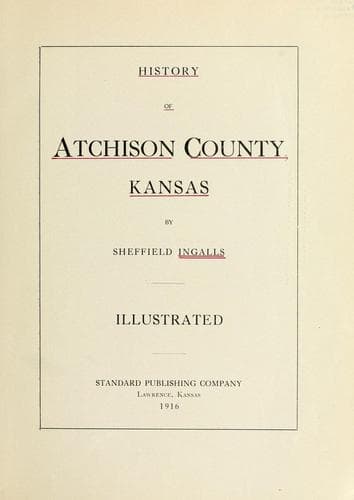
History of Atchison County, KansasIngalls, Sheffield
History
History of Atchison County, Kansas
Ingalls, Sheffield
Atchison County (Kan.) -- Biography; Atchison County (Kan.) -- History
the war, it had reached $175.00 or nearly twenty-seven cents per mile.
It required about 2,750 horses and mules to run the stage line between
Atchison and Placerville. It required, in addition to the regular supply
of horses to operate the stages, some additional animals for
emergencies, and it was estimated that the total cost of the horses on
this stage line was about one-half million dollars. The harness was the
finest that could be made, and cost about $150.00 for a complete set of
four, or about $55,000.00 for the whole line. The feeding of the stock
was one of the big items of expense, and there were annually consumed at
each station from forty to eighty tons of hay, at a cost of $15 to $40
per ton. Each animal was apportioned an average of twelve quarts of corn
every day, which cost from two to ten cents a pound. In the Salt Lake
and California divisions, oats and barley, grown in Utah, were
substituted for corn, but which cost about the same.
There were about 100 Concord coaches which, in the early sixties cost
about $1,000.00 each. The company owned about one-half of the stations,
in addition to thousands of dollars’ worth of miscellaneous property, at
different places along the route. There were superintendents, general
and local attorneys, paymasters and division agents, all of whom drew
big salaries. Among the stage company’s agents in the late fifties and
early sixties were Hugo Richards and Paul Coburn, at Atchison; Robert L.
Pease, of Atchison, was also for a time agent at Denver.
The mail was carried from Atchison west by Forts Kearney, Laramie and
Bridges, once a week. The schedule time from the river to Salt Lake City
was about eighteen days, and the distance was about 1,200 to 1,300
miles.
In 1861 a daily overland mail was established out of Atchison, and with
the exception of a few weeks in 1862, 1864 and 1865, on account of
Indian troubles, the overland was in operation and ran stages daily out
of Atchison for about five years. It was the greatest stage line in the
world, carrying mail, passengers and express. It was also regarded as
the safest and the fastest way to cross the plains, and the mountain
ranges. It was equipped with the latest modern four and six horse and
mule Concord coaches, and the meals at the eating stations along the
route were first-class, and cost from fifty cents to $2.00 each.
Public-domain text, read in full here on John Shaqi.
Reviews
Reviews
No reviews yet
Be the first to share your thoughts on this work.
Elsewhere in the archive
Join the Discussion
Join the discussion
Sign in to leave a comment or review.
Sign InorCreate an account