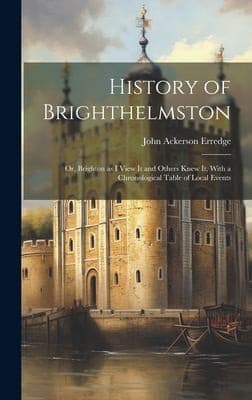
History of Brighthelmston; or, Brighton as I View it and Others Knew It: With a Chronological Table of Local EventsErredge, John Ackerson
History
History of Brighthelmston; or, Brighton as I View it and Others Knew It: With a Chronological Table of Local Events
Erredge, John Ackerson
Brighton (England) -- History
In September, 1810, an attempt was made to constitute the game of Loo an
illegal act. For that purpose informations were lodged against Messrs.
Donaldson and Walker, the proprietors of the Steine and Marine Libraries,
and the case was heard at Lewes, before a full Bench of Magistrates. Mr.
Courthorpe was counsel for the prosecution, and Mr. Adolphus appeared for
the defendants. The only case that was argued was that of an information
against Mr. Walker, founded on the 12th of Geo. II., c. 28, and which was
dwelt on with much force,—such indeed as a confidence of success only
could inspire—by Mr. Courthorpe. To prove that defendant had offended
within the meaning of the Act, and consequently was liable to the penalty
therein expressed, i.e., two hundred pounds, Mrs. White, the wife of one
of the informers, was called and examined. This witness hesitated
considerably in her evidence, particularly when interrogated by Mr.
Adolphus, as to her motive in becoming a subscriber to the Loo amusement
at Walker’s and whether or not she had so acted with the solo aim and
purpose of lodging an information against Mr. Walker, which she at last
admitted. The substance of her evidence was “That she attended at
Walker’s library on the 30th of August; that she stood next to Mr. Walker
on that occasion; that she heard him say, ‘Ladies and gentlemen, three
shillings are only wanting to complete the sweepstake for this elegant
Lady’s Morocco work box;’ that she gave him a shilling for a chance, when
he asked her in what name she would have it, and she said Mrs. Goodlove;
that a lady at length shuffled and cut the cards; that Mr. Walker dealt
them; that the first dealt was called Mr. Bangup; that she won Pam, and
got the prize; that Mr. Walker told her she had won it, and that she was
to receive seven shillings in goods, or subscribe an extra sixpence, and
have two chances for another box of much superior value; that she took
the prize she had won, and lost two shillings in other ventures, &c.”
When questioned by the Earl of Chichester, one of the magistrates, as to
the real value of the prize that had been nominated at 7s., her husband
whispered to her what to say; which being overheard by the Noble Earl,
Mr. White was compelled instantly to quit the room, and to wait without,
that he might be at hand in case he should be wanted. Mr. Adolphus (the
witness being dismissed) addressed the Bench in a most able speech,
concluding by producing an Act of Parliament passed in 1806, by which he
clearly evinced that the present informations could not be sustained, as
the said Act dispossessed magistrates of all jurisdiction and control in
matters of that sort then before them. Mr. Courthorpe laboured hard,
notwithstanding, to gain his point; but as his oratory had not the power
to supersede an Act of Parliament, his labour was in vain. As
authorities in support of the Act he produced, Mr. Adolphus was upheld by
Public-domain text, read in full here on John Shaqi.
Reviews
Reviews
No reviews yet
Be the first to share your thoughts on this work.
Elsewhere in the archive
Join the Discussion
Join the discussion
Sign in to leave a comment or review.
Sign InorCreate an account