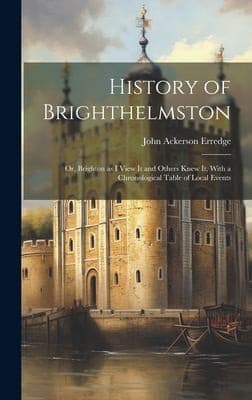
History of Brighthelmston; or, Brighton as I View it and Others Knew It: With a Chronological Table of Local EventsErredge, John Ackerson
History
History of Brighthelmston; or, Brighton as I View it and Others Knew It: With a Chronological Table of Local Events
Erredge, John Ackerson
Brighton (England) -- History
the opinion of the Attorney-General, and a decision in the Court of
King’s Bench. The Magistrates, from what had been brought forward by Mr.
Adolphus, saw their incompetency in so strong a light, that they
dismissed the business, even without hearing the reply which Mr. Adolphus
was about to make to his learned friend. There were three other
informations, all of which of course were withdrawn. The librarians
returned home in high spirits, and the Loo parties, subsequently, and
exulting in the success of the day, were more numerous than usual.
Pam, the good genius of Loo, continued to hold sway at the libraries till
1817, when the magistrates took an antipathy towards him, owing to the
unbounded patronage which he received from the ladies in general. They
considered him an unwelcome resident; so, by their mandate, supported by
an obsolete Act of Henry VIII., he was excommunicated from all the
libraries, as, at this time he had taken up his abode at Mr. T. H.
Wright’s Library, then just established at the south-west corner of
Pavilion Street. Gradually, however, he resumed his position at the
establishments of Lucombe and Tuppen; but notwithstanding the presiding
influence of those two patterers and wits, assisted by Mr. Stacy, the
present librarian at the Royal Albion Rooms, and Mr. Wheeler, the box
book-keeper at the Brighton Theatre, the destruction of the fashionable
promenade, by curtailing the Steine of its fair proportions, so distorted
the throng and habit of fashion, that Pam fell into desuetude and the
libraries, unsupported by him, became failures.
Five and twenty years since, Brighton abounded with libraries, Wright’s,
in the Colonnade, North Street, removed from the Pavilion Parade, and
Eber’s, in Castle Square, a branch of the London establishment, being
amongst the principal of those that then existed. Furnishing food for
the mind, however, was a less profitable speculation than supplying
materials for the understandings, as Mr. Tozer on the former premises,
and Messrs. Dutton and Thorowgood on the latter, by the sale of boots and
shoes, have matured businesses that may vie with any of the same trade in
the kingdom. It is somewhat remarkable, too, that a portion of the
premises in Prince’s Place, occupied by Mr. Lulham, boot and shoemaker,
and the house in the occupation of Messrs. Sharman and Co., North Street,
as a boot and shoe mart, were the library of Mr. Taylor. These facts
certainly confirm the adage,—at any rate when besieged by the multitude
with a civil view,—that “there is nothing like leather.”
From time to time libraries of more or less pretensions have been
started, either by private parties or by societies of membership; but
most of them have become things of the past, which in their short lived
career possessed nothing to warrant a recital of their history.
Public-domain text, read in full here on John Shaqi.
Reviews
Reviews
No reviews yet
Be the first to share your thoughts on this work.
Elsewhere in the archive
Join the Discussion
Join the discussion
Sign in to leave a comment or review.
Sign InorCreate an account