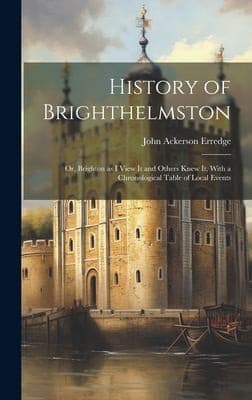
History of Brighthelmston; or, Brighton as I View it and Others Knew It: With a Chronological Table of Local EventsErredge, John Ackerson
History
History of Brighthelmston; or, Brighton as I View it and Others Knew It: With a Chronological Table of Local Events
Erredge, John Ackerson
Brighton (England) -- History
In 1812 the Circus closed from want of support, and for a few years the
premises were occupied as a Bazaar, a speculation which was quite a
failure, although every inducement in the way of loos, lotteries, and
lucky-bags, was introduced, with occasional displays of fireworks and the
ascents of fire-balloons from the parade ground opposite, now the extreme
north Enclosure. At that period, and for some years afterwards, the land
northward from the Pavilion boundary wall to the Level was enclosed with
posts and rails in areas like the present, and formed a public promenade,
and the parade ground of the military. How it became enclosed with iron
railings and planted with trees and flowers, to the exclusion of the
inhabitants, has never been satisfactorily explained. Occasionally
attempts have been made to investigate the business; but inasmuch as
money is required for such a purpose, and the majority of the ratepayers
are contented with the excellent manner the Enclosures are conducted,
they allow the Trustees who have possessed themselves of the right, to
continue in undisturbed possession.
From time to time since the demolition of the Grand Parade Circus,
various troupes of equestrians have visited Brighton. Saunders’s was the
first, his exhibition, which took place on the present site of St.
George’s Place, being termed a Mountebank performance, and consisting,
besides feats of horsemanship, of such tricks as are witnessed in shows
at fairs and races. On Thursday evening, June 21st, 1821, from six to
eight thousand persons assembled to witness the equestrian exploits, &c.,
of this company. In the midst of the amusements one of the scaffoldings,
on which were nearly a hundred persons,—men, women, and children,—gave
way, and the whole fell to the ground, a depth of about four or five
feet. Many persons received severe bruises, and Mr. Siller, of His
Majesty’s private band, had his leg broken in two places. The chief prop
of the scaffolding was some slight paling, the yielding of which to the
great pressure above occasioned the accident, which, under the
circumstances, might have produced far more serious results, as many
persons were immediately under it at the moment. Cook and
Bridges—familiarly known to the juveniles of the time as “Cook and
Breeches,”—afterwards came and took up their position on the Level; and
then followed Ryan, Cooke, Batty, Tournaire, &c., in more or less
permanent buildings; followed by the flying visits of troupes in mammoth
tents. The last erection for the exhibition of horsemanship, and that
still in existence, is the affair in Sussex Street, the hitherto success
of which is evidence that the intelligent portion of the community have
not failed to appreciate the talent which has been produced.
CHAPTER XXV.
BRIGHTON FROM ITS SIMPLICITY TO ITS PRESENT RENOWN.
Public-domain text, read in full here on John Shaqi.
Reviews
Reviews
No reviews yet
Be the first to share your thoughts on this work.
Elsewhere in the archive
Join the Discussion
Join the discussion
Sign in to leave a comment or review.
Sign InorCreate an account