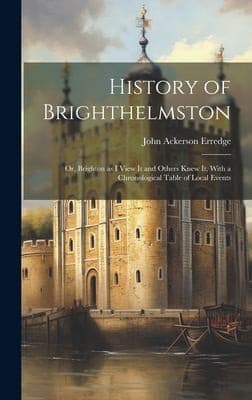
History of Brighthelmston; or, Brighton as I View it and Others Knew It: With a Chronological Table of Local EventsErredge, John Ackerson
History
History of Brighthelmston; or, Brighton as I View it and Others Knew It: With a Chronological Table of Local Events
Erredge, John Ackerson
Brighton (England) -- History
The primitive state of Brighthelmston, both as respects the condition and
habits of the inhabitants and the position and style of the habitations,
must to a considerable extent be left to conjecture, as there is no doubt
the great changes which have taken place in and about the town to give it
the importance which it at present possesses as England’s “Queen of
Watering Places,” have all been effected within the last 150 years.
An engraving in “The Antiquities of England and Wales,” published in
1775, {218} showing the ruins of the Blockhouse at that period, gives a
representation of the houses on the Cliff at the spot whereon now stand
the Old Ship Hotel and the premises adjacent. The south end of
Black-lion Street is very conspicuous, the corner houses consisting only
of dwellings one story in height, of a cottage or hovel-like appearance,
very singular in architectural design when compared with the present
noble block of buildings of Messrs. Hedges and Butler, the wine
merchants, on the east side.
The author of a “Tour through Great Britain,” date, 1724, says:—“Bright
Helmston, commonly called Bredhemston, is a poor fishing town, old built,
and on the very edge of the sea. The fishermen have large barks, in
which they go away to Yarmouth, on the coast of Norfolk, to the fishing
fair there, and hire themselves for the season to catch herrings for the
merchants; and they tell us that these make a very good business of it.
The sea is very unkind to this town, and has, by its continued
encroachments, so gained upon it that in a little time more they might
reasonably expect it would eat up the whole town, above one hundred
houses having been devoured by the water in a few years past; and they
are now obliged to get a brief granted them to beg money all over
England, to raise banks against the water; the expense of which, the
brief expressly says, will be eight thousand pounds; which, if one were
to look on the town, would seem to be more than all the houses in it are
worth.”
The Rev. William Clarke, Rector of Buxted, and grandfather of the
celebrated traveller, thus writes to his friend:—
Brighthelmston, July 22, 1736.
Dear Bowyer,
Public-domain text, read in full here on John Shaqi.
Reviews
Reviews
No reviews yet
Be the first to share your thoughts on this work.
Elsewhere in the archive
Join the Discussion
Join the discussion
Sign in to leave a comment or review.
Sign InorCreate an account