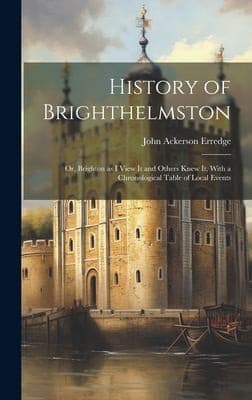
History of Brighthelmston; or, Brighton as I View it and Others Knew It: With a Chronological Table of Local EventsErredge, John Ackerson
History
History of Brighthelmston; or, Brighton as I View it and Others Knew It: With a Chronological Table of Local Events
Erredge, John Ackerson
Brighton (England) -- History
The Rev. William Gilpin, {222} in his “Observations on the Coasts of
Hampshire, Sussex, and Kent,” made in the summer of 1774, observes:—“Soon
after, we reached Brighthelmstone, a disagreeable place. There is
scarcely an object either in it or near it of nature or of art, that
strikes the eye with any degree of beauty,” and then in a somewhat
contradictory manner, adds:—“One of the most picturesque sights we met
with at Brighthelmstone, was the sailing of a fleet of mackarel-boats to
take their evening station for fishing, which they commonly continue
through the night. The sun was just setting when all appeared to be
alive. Every boat began to weigh anchor and unmoor. It was amusing to
see them under so many different forms. Some in a still calm with
flagging sails, were obliged to assist their motion with oars; others
were just getting into the breeze, which rippled the water around them,
and began gently to swell their sails; while the fleet, the water, and
the whole horizon, glowed with one rich harmonious tint from the setting
sun.”
Mrs. P. Hill, in her “Apology,” {223}—now a very rare work,—in 1787, five
years after the Prince of Wales first honoured the town with his
presence, complains of the “doors opening direct into the sittings
rooms,” and of the “inconvenience of not being able to be ‘out’ to any
visitor.”
Bew writes, Sunday, August 30th, 1778:—“This town is built on spots, in
patches, and for want of regularity does not appear to advantage: every
man, as to building, seems to have done what appeared right in his own
eyes. Here is no magistracy: if there is an affray, the parties must go
as far as Lewes, which is much the prettier town, to have it settled.
Upon recollection, this town may be quieter for having no trading
justices resident on the spot. Am since informed, a gentleman in the
commission of the peace attends here occasionally from Lewes.—There can
be no antiquities; for Brighthelmston was only a small obscure village,
occupied by fishermen, till silken Folly and bloated Disease, under the
auspices of a Dr. Russell, deemed it necessary to crowd the shore, and
fill the inhabitants with contempt for their visitors.” In his “Diary,”
also, Tuesday, September 7th, 1779, he writes:—“Am viewing my worthy
friend, Mr. Bull’s house, or rather box, upon the Clift, between Ship
Street and Black-lion Street.—He beckons me in, and shews it throughout.
It is one pretty room to the height of three stories, with a semicircular
window comprising most of the front, and on each floor overlooking the
sea all ways, which makes the situation most delightful. The ground
whereon it stands is copyhold—indeed the ground in and about Brighton is
mostly so—measuring nearly eighteen feet square. The fine is both
certain and small. About fifty years ago, this piece of land was sold
for four pounds; thirty years since, a purchaser gave eleven; and about
this time two years, the Alderman bought it for one hundred pounds to
Public-domain text, read in full here on John Shaqi.
Reviews
Reviews
No reviews yet
Be the first to share your thoughts on this work.
Elsewhere in the archive
Join the Discussion
Join the discussion
Sign in to leave a comment or review.
Sign InorCreate an account