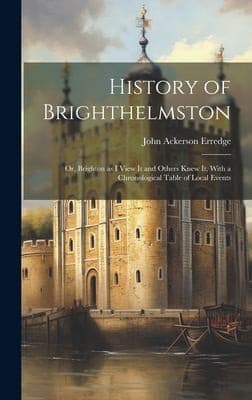
History of Brighthelmston; or, Brighton as I View it and Others Knew It: With a Chronological Table of Local EventsErredge, John Ackerson
History
History of Brighthelmston; or, Brighton as I View it and Others Knew It: With a Chronological Table of Local Events
Erredge, John Ackerson
Brighton (England) -- History
build upon.” The premises here referred to are 35, King’s road, those in
the occupation of Mr. Ridley, boot and shoe maker. In the same Diary,
date Monday, September 7th, 1778, he remarks: “Mr Alderman Bull, of
London, is building a house on the Clift; a semicircular window is in
each story. Am told he meets with many obstacles in the execution of his
design.—Surely it is to the interest of these people (meaning the
inhabitants) to have such men become resident among them; but he is
denied a convenient entrance to his building. A cellar window to the
adjoining house projects before his street door.”
That Brighton at the present day possesses fine architectural features
cannot be denied. The magnificent Squares and Crescents which flank its
sea-frontage, and even form part of the frontage, possess strong claims
on our admiration, especially when we glance at the general state and
style of architecture of our time, and reflect upon the rapid rise and
development of the town—looking to what it was and considering what it
is.
During the close of the last, and the beginning of this century,
architecture had reached its lowest ebb in England. Our true indigenous
Gothic had almost passed into a tradition: the Classic models, from their
extreme ill-adaptation to our climate, had undergone such deterioration,
that the application of the term even to the best of later works was an
absurdity. The influence of Sir Christopher Wren had been of the most
baneful character; not that he was himself deficient in genius, but that
his style, which hardly attains to grandeur even in the Metropolitan
Cathedral, was of a character which inevitably degenerated in feeble
hands. Thus it happened that we were left almost without a national
style, or, at least with one utterly devoid of intrinsic merit of any
kind. The churches and other public buildings were erected upon no
principles; and in accordance only with the taste, or want of taste, in
the architect, who no longer represented an Art, but devoted himself to a
Profession.
Of course, when all the higher and more important offices of architecture
were thus indifferently served, it was not to be expected that
street-architecture would fare very happily. Our streets, in fact,
gradually lost all their picturesqueness and variety of the olden times,
and gained neither dignity nor beauty. Complacent builders shrugged
their shoulders in pity at ancestors who had covered houses with roofs
like over-sized wigs; or had recourse to hanging stories one projecting
over the other until the light of heaven only stole into the streets
through a narrow aperture above the road. But though these things were
quaint and barbarous, there was a something about them which had in it
the sense of beauty,—something which makes one even now prefer the High
Street of Eastgrinstead to the latest built, the most elegant and
supernaturally genteel of our modern terraces.
Public-domain text, read in full here on John Shaqi.
Reviews
Reviews
No reviews yet
Be the first to share your thoughts on this work.
Elsewhere in the archive
Join the Discussion
Join the discussion
Sign in to leave a comment or review.
Sign InorCreate an account