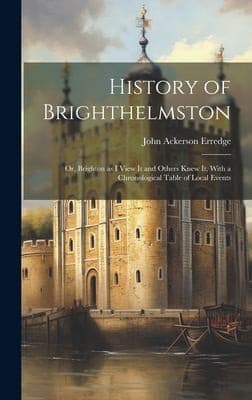
History of Brighthelmston; or, Brighton as I View it and Others Knew It: With a Chronological Table of Local EventsErredge, John Ackerson
History
History of Brighthelmston; or, Brighton as I View it and Others Knew It: With a Chronological Table of Local Events
Erredge, John Ackerson
Brighton (England) -- History
The other public structures erected by the Commissioners are the Market
and the Town Hall. The former is a lofty and commodious building,
standing principally on the site of the Old Workhouse and Town Hall. It
is T shaped, with the transverse head towards the east, opposite the Town
Hall, a building which occupies the space whereon, till the erection of
the new structure, the Market formerly stood. The corner stone of the
Town Hall was laid in April, 1830, by Thomas Read Kemp, Esq., the
contractor for the building being Mr. Doubleday, whose tender was £12,491
1s. 7d. The cost, however, of the building, from the various hewings,
hackings, and cuttings, which it has undergone, has exceeded, at a
moderate calculation, £60,000. It is after the plan of Mr. Thomas
Cooper, but it is minus a most important wing. This defect arose from
the Commissioners omitting to purchase land for the south portion, the
owner of the property refusing to sell after the building had pretty far
advanced. The consequence is that the approaches to the upper rooms of
the southern portion are wanting, and hence much inconvenience is
experienced.
The Town Hall is used for town meetings, public assemblies, the Council
meetings, and the general purposes of the Borough. In it are offices for
the Town Clerk—C. Sharood, Esq.,—and his staff, for the Collectors of the
Municipal and Parish Rates, and for the Borough Surveyor—Mr. Philip
Lockwood,—and his staff. The Magistrates’ Court, which occupies the
southern basement, is likewise used for the Borough Quarter Sessions, the
Recorder being John Locke, Esq., Q.C., and M.P. for Southwark. The
police-force originally established on the 15th of April, 1830, under
Chief-Officer Pilbeam,—the Police Station then being in Steine Lane,—has
at present Mr. George White for the Chief-Constable, he having succeeded
Mr. Chase on the 21st of December, 1853, his predecessor,—who succeeded
Mr. Pilbeam,—Mr. Henry Solomon, having been murdered by John Lawrence, on
the 13th of March, 1844. The Superintendents are Mr. Owen Crowhurst and
Mr. Isaiah Barnden; and the Inspector of Flys, &c., is Mr. James Terry.
The force consists of 80 men,—inspectors, sergeants, and privates,—who
occupy the south-west portion of the basement, immediately contiguous to
the Magistrates’ Court, the dungeons for the uncommitted and, perhaps,
innocent, being in the most remote portion of the underground vaults at
the north-east of the building.
Public-domain text, read in full here on John Shaqi.
Reviews
Reviews
No reviews yet
Be the first to share your thoughts on this work.
Elsewhere in the archive
Join the Discussion
Join the discussion
Sign in to leave a comment or review.
Sign InorCreate an account