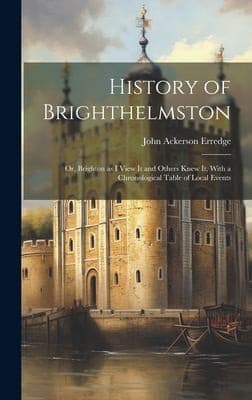
History of Brighthelmston; or, Brighton as I View it and Others Knew It: With a Chronological Table of Local EventsErredge, John Ackerson
History
History of Brighthelmston; or, Brighton as I View it and Others Knew It: With a Chronological Table of Local Events
Erredge, John Ackerson
Brighton (England) -- History
BRIGHTON, August 10th, 1796.—The Duke and Duchess of Marlborough,
with their household, leave here on the 17th inst. Six weeks is
generally the time for their Graces’ residence here, but this summer
they have overstopped their stay. The Duke of Marlborough’s
liberality affords a good and generous lesson to the other nobility
who occasionally reside here; for the victuals and milk (the latter a
scarce article in this town), that is left amongst the household, is
distributed every morning, in parcels, to the poor of the place; a
good day’s provision for several fishermen’s wife and children.
August 18th, 1806.—The Duke and Duchess of Marlborough and Lady A.
Spencer seemed greatly to enjoy, from the windows of Marlborough
House, the parade of the South Gloucester Militia on the Level.—A
crowd of the indigent inhabitants of this place, from the kitchen of
Marlborough House, returned with smiling faces, and aprons, &c., well
filled with provisions, to their families, at an early hour this
morning.
The entrance of Marlborough House was to the west, where the road formed
the public way from East Street to Marlborough Row, which consisted of
nine houses, whereof North House—that now contiguous to the northern
entrance of the Pavilion Grounds—was No. 9. It was a boulder-fronted
house, having adjoining it to the north, Coupland’s blacksmith’s shop,
with three horse-shoes on a board adorning its front. These premises
projected from the front line of the south side of Church Street; and,
connected with them, were the dwelling-houses of Mr. Coupland and Mr.
Beattie, and Beattie’s donkey stables, the whole group of buildings, for
many years after the Pavilion and Grounds became royal property,
disgracing the approach to the Sovereign’s residence and destroying the
uniformity of the street. Eventually, the town purchased the property,
and it was then wholly cleared away. The other houses of Marlborough Row
were cant-bow fronted and were approached by four steps each. They were
principally lodging-houses; but in 1800, No. 2,—opposite Marlborough
House,—was in the occupation of Mr. John Wymark, baker, and in September,
that year, on the occasion of a fire breaking out upon his premises, on a
Saturday night, the Prince of Wales received the unfortunate family, and
exerted himself in protecting their goods, which were taken for safety
into the Pavilion.
Public-domain text, read in full here on John Shaqi.
Reviews
Reviews
No reviews yet
Be the first to share your thoughts on this work.
Elsewhere in the archive
Join the Discussion
Join the discussion
Sign in to leave a comment or review.
Sign InorCreate an account