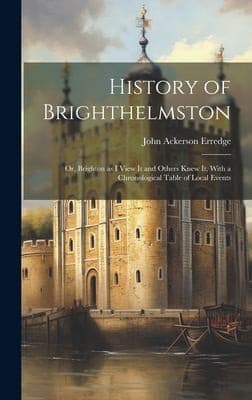
History of Brighthelmston; or, Brighton as I View it and Others Knew It: With a Chronological Table of Local EventsErredge, John Ackerson
History
History of Brighthelmston; or, Brighton as I View it and Others Knew It: With a Chronological Table of Local Events
Erredge, John Ackerson
Brighton (England) -- History
About forty years since “hobby horse” exercise was a very favourite
diversion with the gentry. These “hobbies” were the original
velocipedes, now worked by a crank action; but they then consisted only
of a fore and a hind wheel, with a slight saddle rail between, upon which
the rider sat, holding on by a handle that guided the front wheel, and
then, by striking out his feet with a walking action, the machine became
propelled, its speed being regulated by the ability of the horseman.
Much practice and great judgment were required to make a proficient
rider. Many extraordinary feats of pedestrianism were performed with
these machines; but the most arduous were the competing with the stage
coaches to and from London. The earliest account we have of stage
coaches at Brighton is in 1798, when the Princess of Wales pair-horse or
post-coach was put on the road to London by way of Steyning and Horsham,
the same route by which the eight-horse fly-waggons had previously
travelled. Pack-horses were the only mode of performing the journey
prior to the fly-waggons, and the lanes and bye-ways then being very
narrow, recesses in the hedge-rows were made in certain places to permit
of the laden animals standing aside that they might be passed, as their
packs, which extended considerably on each side of the animals, would
otherwise, frequently come in unpleasant contact with the fair sex, who
on pillions occupied similar positions to merchandize when on horseback.
In 1801, two pair-horse coaches ran between London and Brighton on
alternate days, one up, the other down, and they were driven by Messrs.
Crossweller and Hine. The progress of these coaches was amusing. The
one from London left the Blossoms Inn, Lawrence Lane, at 7 a.m.; the
passengers breaking their fast at the Cock, Sutton, at 9. The next
stoppage for the purpose of refreshment was at the Tangier—Banstead
Downs,—a rural little spot, famous for its elderberry wine, which used to
be brought from the cottage “roking hot,” and, on a cold wintry morning,
few refused to partake of it. George the Fourth invariably stopped here
and took a glass from the hand of Miss Jeal, as he sat in his carriage.
The important business of luncheon took place at Reigate, where
sufficient time was allowed the passengers to view the Barons’ Cave,
where it is said the Barons assembled the night previous to their meeting
King John at Runnymeade. The grand halt, for dinner, was made at
Staplefield Common, celebrated for its famous black cherry trees, under
the branches of which, when the fruit was ripe, the coaches were allowed
to draw up and the passengers to partake of its tempting produce. The
hostess of the hostelry here was famed for her rabbit puddings, which,
hot, were always waiting the arrival of the coach, and to which the
travellers never failed to do such ample justice that ordinarily they
found it quite impossible to leave at the hour appointed; so grogs, pipes
Public-domain text, read in full here on John Shaqi.
Reviews
Reviews
No reviews yet
Be the first to share your thoughts on this work.
Elsewhere in the archive
Join the Discussion
Join the discussion
Sign in to leave a comment or review.
Sign InorCreate an account