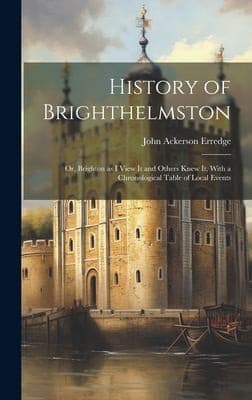
History of Brighthelmston; or, Brighton as I View it and Others Knew It: With a Chronological Table of Local EventsErredge, John Ackerson
History
History of Brighthelmston; or, Brighton as I View it and Others Knew It: With a Chronological Table of Local Events
Erredge, John Ackerson
Brighton (England) -- History
and ale were ordered in, and, to use the language of the fraternity, “not
a wheel wagged” for two hours. Handcross was the next resting place,
celebrated for its “neat” liquors, the landlord of the inn standing
bottle-in-hand at the door. He and several other Bonifaces, at Friar’s
Oak, &c., had the reputation of being on pretty good terms with the
smugglers who carried on their operations with such audacity along the
Sussex Coast. After walking up Clayton Hill a cup of tea was sometimes
found to be necessary at Patcham; after which Brighton was safely reached
at 7 p.m. It must be understood that it was the custom for the
passengers to walk up all the hills, and even sometimes, in heavy
weather, give a push behind to assist the jaded horses.
About 1809, a great revolution took place in coach travelling. Some
gentlemen,—at the head of whom was the late Mr. William Bradford, or, as
he was then styled, “Miller” Bradford,—12 in number, formed a capital by
shares of £100 each, and established two four-horse coaches. The cattle
were cast-horses of the Inniskilling Dragoons, then stationed at
Brighton. In 1815, another vehicle of the same class, the “Bellerophon,”
a huge concern, built with two compartments, one carrying six, the other
four inside, and with several out, was driven by Mr. Hine. This coach
received its name from the ship in which Bonaparte, after his defeat at
Waterloo, was conveyed to exile at St. Helena. The “Bellerophon” was
soon found to be too heavy for the improving speed, and was abandoned for
lighter vehicles, until travelling attained its perfection on the
Brighton road, the time taken in the transit having diminished from
twelve hours to five, and on one occasion the “Quicksilver,” with a
“King’s speech” of William IV., made the journey down in three hours and
forty minutes! From the year 1822, at different periods of the year, not
less than sixty coaches were on the road,—thirty each way.
Public-domain text, read in full here on John Shaqi.
Reviews
Reviews
No reviews yet
Be the first to share your thoughts on this work.
Elsewhere in the archive
Join the Discussion
Join the discussion
Sign in to leave a comment or review.
Sign InorCreate an account