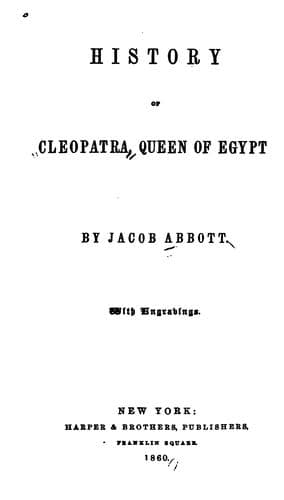
Cleopatra, Queen of Egypt, -30 B.C.; Egypt -- History -- 332-30 B.C. -- Biography; Queens -- Egypt -- Biography
Thus ended the great and famous battle of Philippi, celebrated in history
as marking the termination of the great conflict between the friends and
the enemies of Cæsar, which agitated the world so deeply after the
conqueror's death. This battle established the ascendency of Antony, and
made him for a time the most conspicuous man, as Cleopatra was the most
conspicuous woman, in the world.
CHAPTER X.
CLEOPATRA AND ANTONY.
How far Cleopatra was influenced, in her determination to espouse the
cause of Antony rather than that of Brutus and Cassius, in the civil war
described in the last chapter, by gratitude to Cæsar, and how far, on the
other hand, by personal interest in Antony, the reader must judge.
Cleopatra had seen Antony, it will be recollected, some years before,
during his visit to Egypt, when she was a young girl. She was doubtless
well acquainted with his character. It was a character peculiarly fitted,
in some respects, to captivate the imagination of a woman so ardent, and
impulsive, and bold as Cleopatra was fast becoming.
Antony had, in fact, made himself an object of universal interest
throughout the world, by his wild and eccentric manners and reckless
conduct, and by the very extraordinary vicissitudes which had marked his
career. In moral character he was as utterly abandoned and depraved as it
was possible to be. In early life, as has already been stated, he plunged
into such a course of dissipation and extravagance that he became utterly
and hopelessly ruined; or, rather, he would have been so, had he not, by
the influence of that magic power of fascination which such characters
often possess, succeeded in gaining a great ascendency over a young man of
immense fortune, named Curio, who for a time upheld him by becoming surety
for his debts. This resource, however, soon failed, and Antony was
compelled to abandon Rome, and to live for some years as a fugitive and
exile, in dissolute wretchedness and want. During all the subsequent
vicissitudes through which he passed in the course of his career, the same
habits of lavish expenditure continued, whenever he had funds at his
command. This trait in his character took the form sometimes of a noble
generosity. In his campaigns, the plunder which he acquired he usually
divided among his soldiers, reserving nothing for himself. This made his
men enthusiastically devoted to him, and led them to consider his
prodigality as a virtue, even when they did not themselves derive any
direct advantage from it. A thousand stories were always in circulation in
camp of acts on his part illustrating his reckless disregard of the value
of money, some ludicrous, and all eccentric and strange.
Public-domain text, read in full here on John Shaqi.
Reviews
Reviews
No reviews yet
Be the first to share your thoughts on this work.
Elsewhere in the archive
Join the Discussion
Join the discussion
Sign in to leave a comment or review.
Sign InorCreate an account