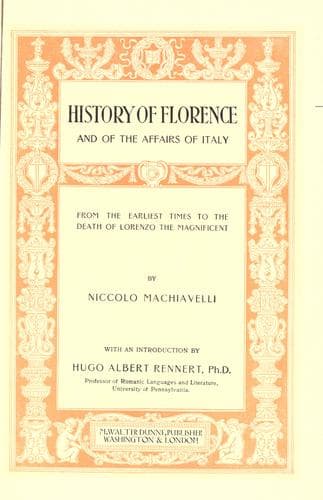
History of Florence and of the Affairs of Italy: From the Earliest Times to the Death of Lorenzo the Magnificent — John Shaqi
History of Florence and of the Affairs of Italy: From the Earliest Times to the Death of Lorenzo the MagnificentMachiavelli, Niccolò
Philosophy
History of Florence and of the Affairs of Italy: From the Earliest Times to the Death of Lorenzo the Magnificent
Machiavelli, Niccolò
Florence (Italy) -- History; Italy -- History -- 476-1492; Italy -- Politics and government
From this devastation and new population arose new languages, as we see
in the different dialects of France, Spain and Italy; which, partaking
of the native idiom of the new people and of the old Roman, formed a
new manner of discourse. Besides, not only were the names of provinces
changed, but also of lakes, rivers, seas, and men; for France, Spain,
and Italy are full of fresh names, wholly different from the
ancient; as, omitting many others, we see that the Po, the Garda, the
Archipelago, are names quite different from those which the ancients
used; while instead of Cæsar and Pompey we have Peter, Matthew, John,
etc.
Among so many variations, that of religion was not of little importance;
for, while combating the customs of the ancient faith with the miracles
of the new, very serious troubles and discords were created among men.
And if the Christians had been united in one faith, fewer disorders
would have followed; but the contentions among themselves, of the
churches of Rome, Greece, and Ravenna, joined to those of the heretic
sects with the Catholics, served in many ways to render the world
miserable. Africa is a proof of this; having suffered more horrors from
the Arian sect, whose doctrines were believed by the Vandals, than from
any avarice or natural cruelty of the people themselves. Living amid so
many persecutions, the countenances of men bore witness of the terrible
impressions upon their minds; for besides the evils they suffered from
the disordered state of the world, they scarcely could have recourse to
the help of God, in whom the unhappy hope for relief; for the greater
part of them, being uncertain what divinity they ought to address, died
miserably, without help and without hope.
Having been the first who put a stop to so many evils, Theodoric
deserves the highest praise: for during the thirty-eight years he
reigned in Italy, he brought the country to such a state of greatness
that her previous sufferings were no longer recognizable. But at his
death, the kingdom descending to Atalaric, son of Amalasontha, his
daughter, and the malice of fortune not being yet exhausted, the old
evils soon returned; for Atalaric died soon after his grandfather, and
the kingdom coming into the possession of his mother, she was betrayed
by Theodatus, whom she had called to assist her in the government. He
put her to death and made himself king; and having thus become odious
to the Ostrogoths, the emperor Justinian entertained the hope of driving
him out of Italy. Justinian appointed Belisarius to the command of this
expedition, as he had already conquered Africa, expelled the Vandals,
and reduced the country to the imperial rule.
Public-domain text, read in full here on John Shaqi.
Reviews
Reviews
No reviews yet
Be the first to share your thoughts on this work.
Join the Discussion
Join the discussion
Sign in to leave a comment or review.
Sign InorCreate an account