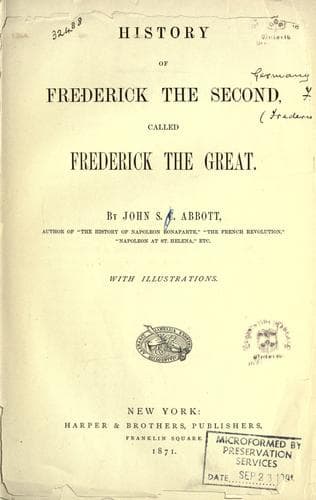
History of Frederick the Second, Called Frederick the Great.Abbott, John S. C. (John Stevens Cabot)
History
History of Frederick the Second, Called Frederick the Great.
Abbott, John S. C. (John Stevens Cabot)
Frederick II, King of Prussia, 1712-1786; Prussia (Germany) -- History -- Frederick II, 1740-1786
But there was another picture which met the eye of the king very
different in its aspect. We know not whether it at all touched his
heart. It was that of the poor peasants, with their mothers, their
wives, their children, hurrying from their hamlets in all directions,
in the utmost dismay. Grandmothers tottered beneath the burden of
infant children. Fathers and mothers struggled on with the household
goods they were striving to rescue from impending ruin. The cry of
maidens and children reached the ear as they fled from the tramp of the
war-horse and the approaching carnage of the death-dealing artillery.
Frederick, having carefully scanned the Austrian lines for an instant
or two, gave the signal, and all his batteries opened their thunders.
Under cover of that storm of iron, several thousand of the cavalry, led
by the veteran General Bredow, deployed from behind some eminences,
and first at a gentle trot, and then upon the most impetuous run, with
flashing sabres, hurled themselves upon the left wing of the Austrian
lines. The ground was dry and sandy, and a prodigious cloud of dust
enveloped them. For a moment the tornado, vital with human energies,
swept on, apparently unobstructed. The first line of the Austrian horse
was met, crushed, annihilated. But the second stood as the rock breasts
the waves, horse against horse, rider against rider, sabre against
sabre. Nothing met the eye but one vast eddying whirlpool of dust, as
if writhing in volcanic energies, while here and there the flash of
fire and the gleam of steel flickered madly through it.
The battle, thus commenced, continued to rage for four long hours,
with all its demon energies, its blood, its wounds, its oaths, its
shrieks, its death; on the right wing, on the left wing, in the centre;
till some ten or twelve thousand, some accounts say more, of these
poor peasant soldiers lay prostrate upon the plain, crushed by the
hoof, torn by the bullet, gashed by the sabre. Many were dead. Many
were dying. Many had received wounds which would cripple them until
they should totter into their graves. At the close of these four hours
of almost superhuman effort, the villages all around in flames, the
Austrians slowly, sullenly retired from the contest. Prince Charles,
having lost nearly seven thousand men, with his remaining forces
breathless, exhausted, bleeding, retired through Czaslau, and vanished
over the horizon to the southwest. Frederick, with his forces almost
equally breathless, exhausted, and bleeding, and counting five thousand
of his soldiers strewn over the plain, in death or wounds, remained
master of the field. Such was the famous battle of Chotusitz.
In the following terms, Frederick, the moment the battle was over,
announced his victory, not to his wife, but to his friend Jordan:
“From the Field of Battle of Chotusitz, May 17, 1742.
Public-domain text, read in full here on John Shaqi.
Reviews
Reviews
No reviews yet
Be the first to share your thoughts on this work.
Elsewhere in the archive
Join the Discussion
Join the discussion
Sign in to leave a comment or review.
Sign InorCreate an account