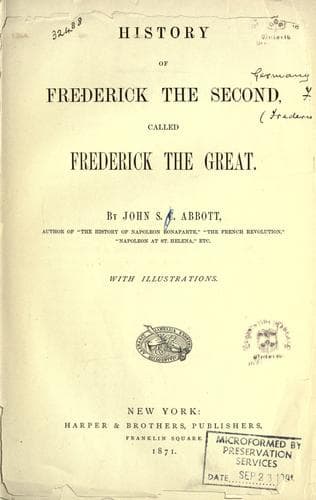
History of Frederick the Second, Called Frederick the Great.Abbott, John S. C. (John Stevens Cabot)
History
History of Frederick the Second, Called Frederick the Great.
Abbott, John S. C. (John Stevens Cabot)
Frederick II, King of Prussia, 1712-1786; Prussia (Germany) -- History -- Frederick II, 1740-1786
“DEAR JORDAN,--I must tell you, as gayly as I can, that we
have beaten the enemy soundly, and that we are all pretty well
after it. Poor Rothenburg is wounded in the breast and in the
arm, but, as it is hoped, without danger. Adieu. You will be
happy, I think, at the good news I send you. My compliments to
Cæsarion.”[66]
Frederick did not pursue the Austrians after this victory. Nine acres
of ground were required to bury the dead. He rented this land from the
proprietor for twenty-five years. His alienation from his allies was
such that, without regard to them, he was disposed to make peace with
Austria upon the best terms he could for himself. England also, alarmed
in view of the increasing supremacy of France, was so anxious to detach
Frederick, with his invincible troops, from the French alliance, that
the British cabinet urged Maria Theresa to make any sacrifice whatever
that might be necessary to secure peace with Prussia. Frederick,
influenced by such considerations, buried the illustrious Austrian
dead with the highest marks of military honor, and treated with marked
consideration his distinguished prisoners of war.
Secret negotiations were immediately opened at Breslau, in Silesia,
between England, Austria, and Prussia. Maria Theresa, harassed by the
entreaties of her cabinet and by the importunities of the British
court, consented to all that Frederick demanded.
The French, who, through their shrewd embassador, kept themselves
informed of all that was transpiring, were quite alarmed in view of the
approaching accommodation between Prussia and Austria. It is said that
Frederick, on the 6th of June, in reply to the earnest remonstrances of
the French minister, Marshal Belleisle, against his withdrawal from the
alliance, frankly said to him,
“All that I ever wanted, more than I ever demanded, Austria now offers
me. Can any one blame me that I close such an alliance as ours all
along has been, when such terms are presented to me as Austria now
proposes?”
On the 15th of June Frederick gave a grand dinner to his generals at
his head-quarters. In an after-dinner speech he said to them,
“Gentlemen, I announce to you that, as I never wished to oppress the
Queen of Hungary, I have formed the resolution of agreeing with that
princess, and accepting the proposals she has made me, in satisfaction
of my rights.”
Toasts were then drank with great enthusiasm to the health of “Maria
Theresa, Queen of Hungary,” to “the queen’s consort, Francis,
Grand-duke of Lorraine;” and universal and cordial was the response of
applause when the toast was proposed “to the brave Prince Charles.”
Public-domain text, read in full here on John Shaqi.
Reviews
Reviews
No reviews yet
Be the first to share your thoughts on this work.
Elsewhere in the archive
Join the Discussion
Join the discussion
Sign in to leave a comment or review.
Sign InorCreate an account