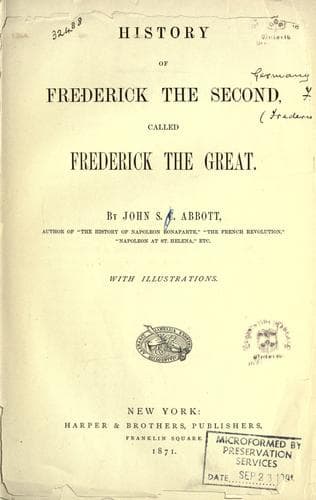
History of Frederick the Second, Called Frederick the Great.Abbott, John S. C. (John Stevens Cabot)
History
History of Frederick the Second, Called Frederick the Great.
Abbott, John S. C. (John Stevens Cabot)
Frederick II, King of Prussia, 1712-1786; Prussia (Germany) -- History -- Frederick II, 1740-1786
His withdrawal from the French alliance removed the menace from the
English Hanoverian possession. George II. eagerly sent an army of sixty
thousand men to the aid of Maria Theresa against France, and freely
opened to her his purse. The French were defeated every where. They
were driven from Prague in one of the most disastrous wintry retreats
of blood and misery over which the demon of war ever gloated. The
powerless, penniless emperor, the creature of France, who had neither
purse nor army, was driven, a fugitive and a vagabond, from his petty
realm of Bavaria, and was exposed to humiliation, want, and insult.
Maria Theresa was developing character which attracted the admiration
of Europe. She seriously contemplated taking command of her armies
herself. She loved Duke Francis, her husband, treated him very
tenderly, and was anxious to confer upon him honor; but by nature
vastly his superior, instinctively she assumed the command. She led;
he followed. She was a magnificent rider. Her form was the perfection
of grace. Her beautiful, pensive, thoughtful face was tanned by the
weather. All hearts throbbed as, on a spirited charger, she sometimes
swept before the ranks of the army, with her gorgeous retinue,
appearing and disappearing like a meteor. She was as devout as she was
brave, winning the homage of all Catholic hearts. We know not where, in
the long list of sovereigns, to point to man or woman of more imperial
energies, of more exalted worth.
[Illustration: MARIA THERESA AT THE HEAD OF HER ARMY.]
The loss of Silesia she regarded as an act of pure highway robbery. It
rankled in her noble heart as the great humiliation and disgrace of her
reign. Frederick was to her but as a hated and successful bandit, who
had wrenched from her crown one of its brightest jewels. To the last
day of her life she never ceased to deplore the loss. It is said that
if any stranger, obtaining an audience, was announced as from Silesia,
the eyes of the queen would instantly flood with tears. But the
fortunes of war had now triumphantly turned in her favor. Aided by the
armies and the gold of England, she was on the high career of conquest.
Her troops had overrun Bohemia and Bavaria. She was disposed to hold
those territories in compensation for Silesia, which she had lost.
In the mean time, during the two years in which Maria Theresa was
making these conquests, Frederick, alarmed by the aggrandizement of
Austria and the weakening of France, while unavailingly striving
to promote peace, was busily employed in the administration of his
internal affairs. He encouraged letters; devoted much attention to the
Academy of Arts and Sciences; reared the most beautiful opera-house in
Europe; devoted large sums to secure the finest musicians and the most
exquisite ballet-dancers which Europe could afford. He sought to make
his capital attractive to all those throughout Europe who were inspired
by a thirst for knowledge, or who were in the pursuit of pleasure.
Public-domain text, read in full here on John Shaqi.
Reviews
Reviews
No reviews yet
Be the first to share your thoughts on this work.
Elsewhere in the archive
Join the Discussion
Join the discussion
Sign in to leave a comment or review.
Sign InorCreate an account