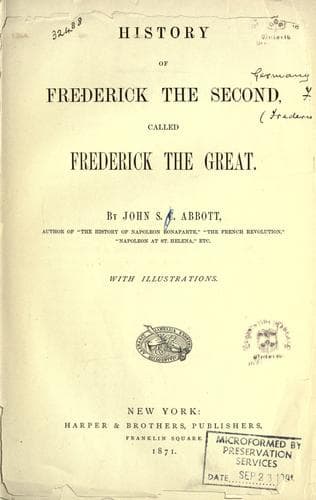
History of Frederick the Second, Called Frederick the Great.Abbott, John S. C. (John Stevens Cabot)
History
History of Frederick the Second, Called Frederick the Great.
Abbott, John S. C. (John Stevens Cabot)
Frederick II, King of Prussia, 1712-1786; Prussia (Germany) -- History -- Frederick II, 1740-1786
“I have prescribed,” he said, “the conditions of peace to the Queen of
Hungary. She accepts them. Having, therefore, all that I want, I make
peace. All the world in my situation would do the same.”
“Is it possible, sire,” Marshal Belleisle replied, “that you can dare
to abandon the best of your allies, and to deceive so illustrious a
monarch as the King of France?”
“And you, sir,” responded the king, with an air of great disdain, at
the same time placing in his hand the cardinal’s letter, “do you dare
to talk to me in this manner?”
The marshal glanced his eye over the document, and retired, overwhelmed
with confusion. Thus ended the alliance between Prussia and France.
“Each party,” writes Frederick, “wished to be more cunning than the
other.”[69]
In the following terms, Frederick correctly sums up the incidents of
the two Silesian campaigns:
“Thus was Silesia reunited to the dominions of Prussia. Two years of
war sufficed for the conquest of this important province. The treasure
which the late king had left was nearly exhausted. But it is a cheap
purchase, where whole provinces are bought for seven or eight millions
of crowns. The union of circumstances at the moment peculiarly favored
this enterprise. It was necessary for it that France should allow
itself to be drawn into the war; that Russia should be attacked by
Sweden; that, from timidity, the Hanoverians and Saxons should remain
inactive; that the successes of the Prussians should be uninterrupted;
and that the King of England, the enemy of Prussia, should become, in
spite of himself, the instrument of its aggrandizement. What, however,
contributed the most to this conquest was an army which had been formed
for twenty-two years, by means of a discipline admirable in itself,
and superior to the troops of the rest of Europe. Generals, also, who
were true patriots, wise and incorruptible ministers, and, finally, a
certain good fortune which often accompanies youth, and often deserts a
more advanced age.”[70]
There was no end to the panegyrics which Voltaire, in his
correspondence with Frederick, now lavished upon him. He greeted him
with the title of Frederick the Great.
“How glorious,” he exclaimed, “is my king, the youngest of kings, and
the grandest! A king who carries in the one hand an all-conquering
sword, but in the other a blessed olive-branch, and is the arbiter of
Europe for peace or war.”
Frederick, having obtained all that, for the present, he could hope
to obtain, deemed it for his interest to attempt to promote the peace
of Europe. His realms needed consolidating, his army recruiting, his
treasury replenishing. But he found it much easier to stir up the
elements of strife than to allay them.
Public-domain text, read in full here on John Shaqi.
Reviews
Reviews
No reviews yet
Be the first to share your thoughts on this work.
Elsewhere in the archive
Join the Discussion
Join the discussion
Sign in to leave a comment or review.
Sign InorCreate an account