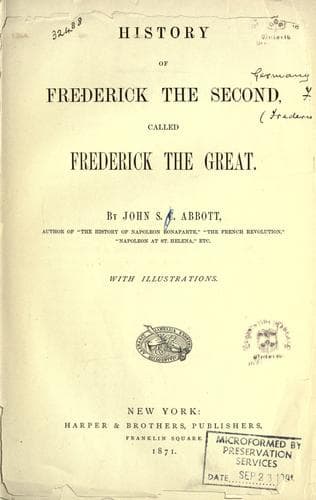
History of Frederick the Second, Called Frederick the Great.Abbott, John S. C. (John Stevens Cabot)
History
History of Frederick the Second, Called Frederick the Great.
Abbott, John S. C. (John Stevens Cabot)
Frederick II, King of Prussia, 1712-1786; Prussia (Germany) -- History -- Frederick II, 1740-1786
The heir to the Russian throne was an orphan boy, Peter Federowitz.
The Russian court was looking around to obtain for him a suitable
wife. Frederick’s commandant at Stettin, a man of renowned lineage,
had a beautiful daughter of fourteen. She was a buxom girl, full of
life as she frolicked upon the ramparts of the fortress with her young
companions. Frederick succeeded in obtaining her betrothal to the young
Prince of Russia. She was solemnly transferred from the Protestant to
the Greek religion; her name was changed to Catharine; and she was
eventually married, greatly to the satisfaction of Frederick, to the
young Russian czar.
Adolph Frederick was the heir to the throne of Sweden. Successful
diplomacy brought a magnificent embassy from Stockholm to Berlin, to
demand Princess Ulrique as the bride of Sweden’s future king. The
course of love, whether true or false, certainly did in this case run
smooth. The marriage ceremony was attended in Berlin with such splendor
as the Prussian capital had never witnessed before. The beautiful
Ulrique was very much beloved. She was married by proxy, her brother
Augustus William standing in the place of the bridegroom.
All eyes were dimmed with tears as, after a week of brilliant
festivities, she prepared for her departure. The carriages were at the
door to convey her, with her accompanying suite of lords and ladies, to
Stralsund, where the Swedish senate and nobles were to receive her.
The princess entered the royal apartment to take leave of her friends,
dressed in a rose-colored riding-habit trimmed with silver. The vest
which encircled her slender waist was of sea-green, with lappets
and collar of the same. She wore a small English bonnet of black
velvet with a white plume. Her flowing hair hung in ringlets over her
shoulders, bound with rose-colored ribbon.
The king, who was devotedly attached to his sister, and who was very
fond, on all occasions, of composing rhymes which he called poetry,
wrote a very tender ode, bidding her adieu. It commenced with the words
“Partez, ma sœur, partez;
La Suède vous attend, la Suède
vous désire.”
Go, my sister, go;
Sweden waits you, Sweden
wishes you.
“His majesty gave it to her at the moment when she was about to
take leave of the two queens. The princess threw her eyes on it and
fell into a faint. The king had almost done the like. His tears
flowed abundantly. The princes and princesses were overcome with
sorrow. At last Gotter judged it time to put an end to this tragic
scene. He entered the hall almost like Boreas in the ballet of “The
Rose”--that is to say, with a crash. He made one or two whirlwinds,
clove the press, and snatched away the princess from the arms of the
queen-mother, took her in his own, and whisked her out of the hall. All
the world followed. The carriages were waiting in the court, and the
princess in a moment found herself in hers.
Public-domain text, read in full here on John Shaqi.
Reviews
Reviews
No reviews yet
Be the first to share your thoughts on this work.
Elsewhere in the archive
Join the Discussion
Join the discussion
Sign in to leave a comment or review.
Sign InorCreate an account