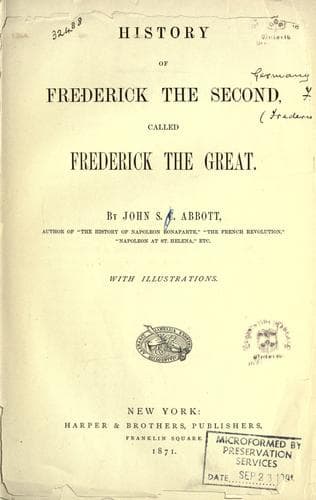
History of Frederick the Second, Called Frederick the Great.Abbott, John S. C. (John Stevens Cabot)
History
History of Frederick the Second, Called Frederick the Great.
Abbott, John S. C. (John Stevens Cabot)
Frederick II, King of Prussia, 1712-1786; Prussia (Germany) -- History -- Frederick II, 1740-1786
“I was in such a state I know not how we got down stairs. I remember
only that it was in a concert of lamentable sobbings. Madame, the
Marchioness of Schwedt, who had been named to attend the princess to
Stralsund, on the Swedish frontier, this high lady, and the two dames
D’Atours, who were for Sweden itself, having sprung into the same
carriage, the door of it was shut with a slam, the postillions cracked,
the carriage shot away, and disappeared from our eyes. In a moment the
king and court lost sight of the beloved Ulrique forever.”[73]
Frederick was far from being an amiable man. He would often cruelly
banter his companions, knowing that it was impossible for them to
indulge in any retort. Baron Pöllnitz was a very weak old man, who
had several times changed his religion to subserve his private
interests. He had been rather a petted courtier during three reigns.
Now, in extreme old age, and weary of the world, he wished to renounce
Protestantism, and to enter the cloisters of the convent in preparation
for death. He applied to the king for permission to do so. Frederick
furnished him with the following sarcastic parting testimony. It was
widely circulated through many of the journals of that day, exciting
peals of laughter as a capital royal joke:
“Whereas the Baron De Pöllnitz, born of honest parents, so far
as we know, having served our grandfather as gentleman of the
chamber, Madame D’Orleans in the same rank, the King of Spain as
colonel, the deceased Emperor Charles VI. as captain of horse,
the pope as chamberlain, the Duke of Brunswick as chamberlain,
the Duke of Weimar as ensign, our father as chamberlain, and, in
fine, _us_ as grand master of ceremonies, has, notwithstanding
such accumulation of honors, become disgusted with the world, and
requests of us a parting testimony;
“We, remembering his important services to our house in diverting
for nine years long the late king our father, and doing the
honors of our court through the now reign, can not refuse such
request. We do hereby certify that the said Baron Pöllnitz has
never assassinated, robbed on the highway, poisoned, forcibly
cut purses, or done other atrocity or legal crime at our court;
but that he has always maintained gentlemanly behavior, making
not more than honest use of the industry and talents he has
been endowed with at birth; imitating the object of the drama--
that is, correcting mankind by gentle quizzing--following in
the matter of sobriety Boerhaave’s counsels, pushing Christian
charity so far as often to make the rich understand that it is
more blessed to give than to receive; possessing perfectly the
anecdotes of our various mansions, especially of our worn-out
furnitures, rendering himself by his merits necessary to those
who know him, and, with a very bad head, having a very good heart.
Public-domain text, read in full here on John Shaqi.
Reviews
Reviews
No reviews yet
Be the first to share your thoughts on this work.
Elsewhere in the archive
Join the Discussion
Join the discussion
Sign in to leave a comment or review.
Sign InorCreate an account