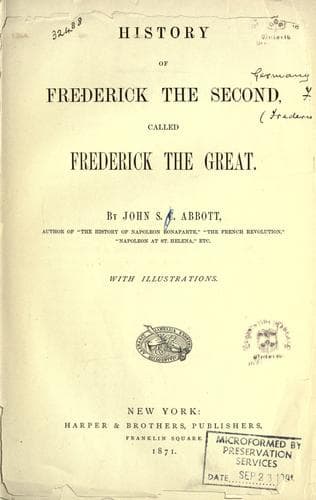
History of Frederick the Second, Called Frederick the Great.Abbott, John S. C. (John Stevens Cabot)
History
History of Frederick the Second, Called Frederick the Great.
Abbott, John S. C. (John Stevens Cabot)
Frederick II, King of Prussia, 1712-1786; Prussia (Germany) -- History -- Frederick II, 1740-1786
“Our anger the said Baron Pöllnitz never kindled but once.[74]
But as the loveliest countries have their barren spots, the most
beautiful forms their imperfections, pictures by the greatest
masters their faults, we are willing to cover with the veil of
oblivion those of the said baron. We do hereby grant him, with
regret, the leave of absence he requires, and abolish his office
altogether, that it may be blotted from the memory of man, not
judging that any one, after the said baron, can be worthy to fill
it.
“FREDERICK.
“Potsdam, April 1, 1744.”
No man of kindly sympathies could have thus wantonly wounded the
feelings of a poor old man who had, according to his capacity, served
himself, his father, and his grandfather, and who was just dropping
into the grave. A generous heart would have forgotten the foibles, and,
remembering only the virtues, would have spoken words of cheer to the
world-weary heart, seeking a sad refuge in the glooms of the cloister.
It must be confessed that Frederick often manifested one of the worst
traits in human nature. He took pleasure in inflicting pain upon others.
CHAPTER XIX.
THE INVASION OF BOHEMIA.
Correspondence between Frederick and Voltaire.--Voltaire’s Visit to
Frederick.--Domestic Habits of the King.--Unavailing Diplomacy
of Voltaire.--The New Alliance.--The Renewal of War.--The Siege
of Prague.--The Advance upon Vienna.--Darkening Prospects.--The
Pandours.--Divisions in Council.--Sickness of Louis XV.--Energy of
Frederick.--Distress of the Army.
The correspondence carried on between Frederick and Voltaire, and their
mutual comments, very clearly reveal the relations existing between
these remarkable men. Frederick was well aware that the eloquent pen of
the great dramatist and historian could give him celebrity throughout
Europe. Voltaire was keenly alive to the consideration that the
friendship of a monarch could secure to him position and opulence. And
yet each privately spoke of the other very contemptuously, while in
the correspondence which passed between them they professed for each
other the highest esteem and affection. Frederick wrote from Berlin as
follows to Voltaire:
“October 7, 1743.
“MY DEAR VOLTAIRE,--France has been considered thus far as the
asylum of unfortunate monarchs. I wish that my capital should
become the temple of great men. Come to it, then, my dear
Voltaire, and give whatever orders can tend to render a residence
in it agreeable to you. My wish is to please you, and wishing
this, my intention is to enter entirely into your views.
Public-domain text, read in full here on John Shaqi.
Reviews
Reviews
No reviews yet
Be the first to share your thoughts on this work.
Elsewhere in the archive
Join the Discussion
Join the discussion
Sign in to leave a comment or review.
Sign InorCreate an account